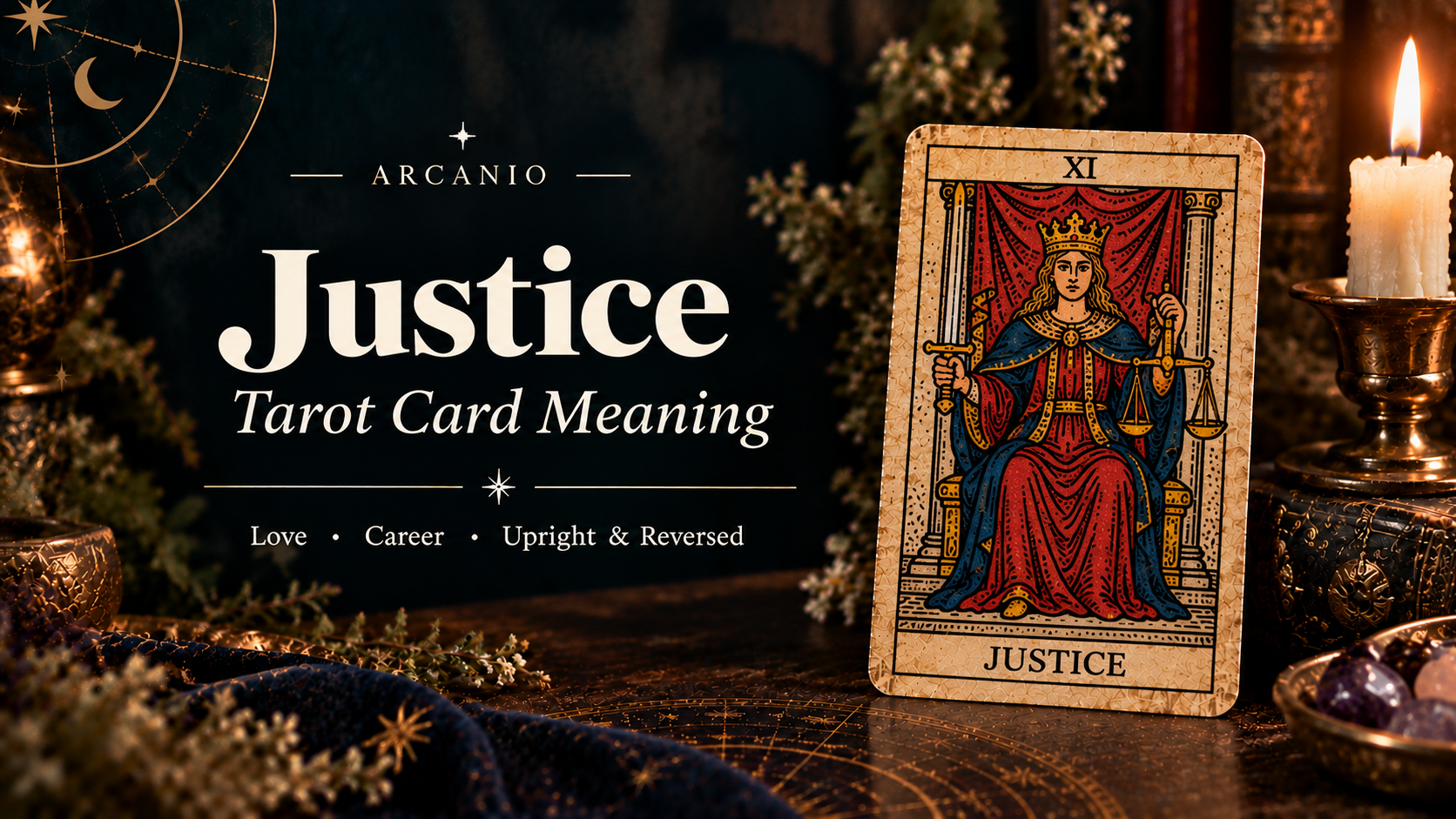
The Justice tarot card meaning is connected to fairness, truth, accountability, and the consequences of our choices. When Justice appears in a reading, it invites you to look at a situation honestly, recognize your responsibilities, and consider whether your actions reflect your values. This card is not simply about punishment or reward. It is about seeing things clearly, weighing different perspectives, and making decisions with care.
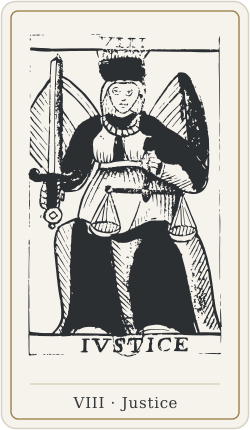
In the Marseille tarot tradition, Justice is numbered VIII and occupies an important place among the Major Arcana. In the historic Jean Noblet-inspired deck used by Arcanio, the card belongs to a visual language of bold lines, symbolic objects, and expressive figures. Justice holds a sword and scales, bringing together two complementary ideas: the ability to distinguish truth from falsehood and the need to weigh a situation before reaching a conclusion.
Justice can appear when you are making a difficult decision, navigating a relationship, considering a career change, or reflecting on the results of past actions. It may ask you to stand up for yourself, acknowledge an uncomfortable truth, or restore balance where something has become unfair. Its message is especially valuable when emotions are strong and the temptation to act too quickly is difficult to resist.
In this guide, you will discover the Justice tarot card meaning in upright and reversed positions, including love, career, money, personal growth, spirituality, yes-or-no questions, and three-card readings. You will also learn how to interpret its traditional Marseille symbolism and understand what Justice may mean when it appears alongside other tarot cards.
Justice Tarot Card Meaning at a Glance
Justice represents truth, fairness, responsibility, balance, and clear judgment. It encourages you to examine the facts, understand the consequences of your choices, and act according to your principles rather than temporary emotions.
Upright Justice: Fairness, truth, accountability, honest decisions, balance, integrity, and consequences.
Reversed Justice: Unfair treatment, dishonesty, avoidance of responsibility, bias, imbalance, and difficulty accepting the truth.
Love: Honest communication, equal partnership, commitment, boundaries, and shared responsibility.
Career: Ethical decisions, contracts, evaluations, professional accountability, and fair recognition.
Money: Careful budgeting, financial responsibility, clear agreements, and balanced decisions.
Yes or no: Usually yes when the situation is fair, evidence supports your position, and you are willing to accept the consequences. The answer may be conditional when important facts remain unclear.
Elemental association: Justice is commonly associated with Air in modern tarot systems, although interpretations and correspondences can differ between traditions.
Marseille number: VIII.
The central question of Justice is simple: Are you seeing the situation clearly, and are you prepared to act fairly?
What Does the Justice Tarot Card Mean?
Justice asks you to look beyond what you want to be true and examine what is actually happening. It is a card of discernment, encouraging you to separate facts from assumptions and to consider the effects of your decisions on yourself and others. When it appears, a situation may require greater honesty, a difficult conversation, or a choice that cannot be made responsibly without examining the evidence.
This card is often associated with consequences, but its meaning is broader than the idea that people simply get what they deserve. Life is not always fair, and Justice does not promise that every outcome will be perfect. Instead, it emphasizes the importance of responding to circumstances with integrity. Even when you cannot control the final result, you can control whether your actions reflect honesty and care.
Justice may also point toward a moment when you need to take responsibility. Perhaps you have delayed a decision, avoided a conversation, or hoped that a problem would resolve itself. The card encourages you to stop postponing what needs attention. Acknowledging your part in a situation does not mean accepting blame for everything. It means recognizing what belongs to you and deciding what to do with that knowledge.
In relationships, Justice highlights mutual respect and equal effort. At work, it can point to contracts, formal evaluations, negotiations, or ethical questions. In personal development, it encourages self-awareness and the courage to admit when your beliefs or behavior need to change.
Justice is not necessarily a cold or unforgiving card. Fairness requires compassion as well as clear judgment. Its deeper lesson is that understanding a situation accurately gives you a stronger foundation for making a wise decision.
Upright Justice Tarot Card Meaning
When Justice appears upright, it usually emphasizes honesty, accountability, and balanced judgment. You may be approaching an important decision or reaching a point where the facts can no longer be ignored. The card encourages you to slow down, examine the available information, and make your choice based on what you know rather than what you fear or hope.
Upright Justice can be a positive sign when you are acting honestly and dealing with a situation transparently. It suggests that careful preparation, clear communication, and consistent behavior can help you navigate the circumstances ahead. If you have been working toward a fair resolution, the card encourages you to remain organized and patient rather than allowing frustration to determine your next move.
It may also represent a need to correct an imbalance. You might be giving too much in a relationship, accepting responsibilities that belong to someone else, or overlooking a problem because addressing it would be uncomfortable. Justice asks you to identify the imbalance and respond constructively.
However, upright Justice does not automatically promise victory or guarantee that another person will agree with you. Sometimes its most important message is that you need to reconsider your own position. If the evidence challenges your assumptions, be willing to change your mind.
The card ultimately supports decisions made with integrity. You do not need to be perfect to embody Justice. You need to be willing to see the truth, acknowledge your responsibilities, and make the fairest decision you can with the information available.
Upright Justice Keywords
Truth, fairness, accountability, integrity, rational thinking, balanced judgment, responsibility, honesty, and consequences.
Reversed Justice Tarot Card Meaning
Reversed Justice can suggest that something is out of balance or that the truth is being avoided. You may feel that you have been treated unfairly, that someone is refusing to take responsibility, or that a decision is being influenced by prejudice rather than evidence. In other situations, the card asks you to consider whether your own judgment has become distorted by anger, fear, pride, or personal interest.
When you believe you have been wronged, reversed Justice encourages you to distinguish between what you know and what you suspect. Your feelings deserve attention, but they do not always provide a complete account of what happened. Gathering information, documenting important details, and seeking an independent perspective may help you understand the situation more clearly.
This card can also appear when you are avoiding accountability. Perhaps you know that an apology is necessary, a commitment has been neglected, or a decision has caused harm. It may be tempting to focus entirely on another person's mistakes, but reversed Justice asks you to examine your own contribution without becoming trapped in shame.
In relationships, the card may indicate unequal effort, broken agreements, or conversations in which neither person feels heard. At work, it can suggest unclear expectations, unfair treatment, or decisions that lack transparency. Financially, it may encourage you to review agreements, spending habits, or obligations that have been neglected.
Reversed Justice does not prove that someone is lying or that an injustice will occur. Tarot cards cannot establish facts about another person's intentions or predict a legal outcome with certainty. Instead, this card invites you to investigate carefully, question assumptions, and avoid decisions based on incomplete information.
Its constructive message is to restore balance wherever possible. That may involve setting a boundary, correcting a mistake, requesting clarification, or accepting that you cannot control every outcome.
Reversed Justice Keywords
Injustice, bias, dishonesty, imbalance, avoidance, unfair judgment, denial, and difficulty accepting responsibility.
Justice Tarot Card Meaning in Love and Relationships
In love readings, Justice highlights honesty, mutual respect, clear expectations, and the balance between giving and receiving. It encourages you to look at the relationship as it actually exists rather than relying exclusively on promises, attraction, or the hope that things will eventually improve.
Upright Justice in Love
If you are in a relationship, upright Justice encourages an honest discussion about what both partners need. Are responsibilities shared fairly? Can you express your concerns without fear of being dismissed? Do your actions support the promises you make to each other? These questions can help you understand whether the relationship has a healthy foundation.
Justice can be associated with commitment, formal agreements, or decisions about the future. For some couples, it may coincide with discussions about marriage, shared finances, living arrangements, or other important responsibilities. The card does not guarantee that these events will happen, but it emphasizes making such decisions openly and thoughtfully.
If you are single, Justice invites you to consider the standards you bring to new relationships. You deserve respect, but a healthy partnership also requires you to offer respect in return. Reflecting on previous relationships may help you recognize patterns, establish clearer boundaries, and choose partners whose actions are consistent with their words.
Reversed Justice in Love
Reversed Justice may indicate that a relationship feels unequal or that an important truth has not been addressed. One partner might be carrying most of the emotional work, difficult conversations may repeatedly be postponed, or disagreements may turn into competitions over who is right.
The card encourages you to identify the real issue instead of focusing only on who should apologize first. A productive conversation requires both people to listen, explain their perspectives, and acknowledge the impact of their behavior.
For singles, reversed Justice can invite reflection on recurring relationship patterns. You may be judging new people through the experiences of a previous relationship or overlooking warning signs because you want a particular connection to succeed.
Justice does not tell you to stay in an unhealthy relationship simply to preserve balance. Fairness includes respecting your own needs and recognizing when a boundary or separation may be necessary.
Justice Tarot Card Meaning in Career and Work
In career readings, Justice represents professionalism, ethical conduct, fair evaluation, and decisions that require careful consideration. It can appear when you are negotiating an agreement, applying for a position, receiving feedback, changing jobs, or deciding how to respond to a difficult workplace situation.
Upright Justice in Career
Upright Justice encourages you to approach professional decisions with preparation and integrity. Review the details before signing a contract, communicate your expectations clearly, and make sure important agreements are understood by everyone involved. If you are negotiating a salary or discussing responsibilities, the card favors a reasoned case supported by evidence.
Justice may also draw attention to accountability and recognition. If you have contributed consistently to a project, keep track of your work and explain its value clearly. If you are responsible for a mistake, acknowledge it and focus on how to correct it.
For business owners and independent professionals, the card emphasizes transparent policies, accurate records, fair pricing, and clear relationships with clients. Long-term trust is easier to maintain when expectations are realistic and agreements are honored.
Reversed Justice in Career
Reversed Justice can reflect frustration with unfair treatment, inconsistent rules, unclear responsibilities, or a workplace where accountability is applied unevenly. It may also suggest that a disagreement has become personal and needs to be brought back to verifiable facts.
If you feel overlooked, document your contributions and ask for specific feedback rather than relying on assumptions about your manager's motives. If you are considering leaving a position, review your practical circumstances and contractual obligations before making a sudden decision.
The card can also ask you to examine your own professional conduct. Are you communicating clearly? Are you meeting the commitments you have made? Are you evaluating colleagues consistently? Taking responsibility for what you can change may give you more options than remaining focused on what feels unfair.
Justice Tarot Card Meaning for Money and Finances
Justice in financial readings emphasizes planning, accountability, and informed choices. It encourages you to understand the full picture before making a commitment and to avoid allowing short-term excitement or anxiety to determine how you use your money.
Upright Justice in Money Readings
Upright Justice supports careful budgeting, reviewing financial agreements, comparing costs, and keeping accurate records. If you are considering a loan, major purchase, or shared financial commitment, make sure you understand the terms and the potential consequences.
The card can also encourage a more balanced approach to spending and saving. Rather than treating money decisions as a test of willpower, examine your actual income, obligations, and priorities. A realistic plan can help you make choices that are consistent with your longer-term goals.
Justice may be relevant when you need to resolve a financial disagreement or clarify who is responsible for a particular expense. Clear communication and written records can reduce misunderstandings.
Reversed Justice in Money Readings
Reversed Justice invites you to examine financial imbalance, overlooked obligations, unclear agreements, or decisions made without enough information. You may need to review subscriptions, outstanding payments, shared expenses, or a budget that no longer reflects your circumstances.
If another person is involved in a financial dispute, avoid making accusations without evidence. Check the relevant documents and seek qualified financial or legal advice when necessary. The card is a reminder to investigate responsibly, not proof that anyone has acted dishonestly.
Financial fairness also includes being realistic about what you can afford. If you have made a mistake, acknowledging it early may make it easier to develop a workable plan.
Justice Tarot Card Meaning for Personal Growth
Justice is a powerful card for self-reflection because it asks you to become more honest about your own choices. It encourages you to examine your behavior without either excusing everything you do or condemning yourself for every mistake.
Personal growth begins when you can recognize the difference between intention and impact. You may have meant well and still hurt someone. You may have made a reasonable decision with the information available and later discovered that it was wrong. Justice encourages you to learn from these experiences rather than becoming defensive or allowing regret to define you.
The card also highlights the importance of boundaries. Being fair does not mean pleasing everyone, accepting every request, or giving other people unlimited access to your time. It means considering everyone's needs while recognizing that your own needs matter too.
When Justice appears during a period of self-examination, ask yourself whether your daily actions reflect your stated values. If you value honesty, are you communicating truthfully? If you value balance, are you allowing yourself enough rest? If you value respect, are you treating yourself with the same consideration you offer others?
Reversed Justice may suggest that you are judging yourself too harshly or refusing to recognize a pattern that needs to change. Growth requires accountability, but accountability is not the same as self-punishment. You can admit a mistake, make amends where possible, and choose a better response in the future.
Justice Tarot Card Meaning in Spirituality
Spiritually, Justice represents alignment between your beliefs, intentions, and actions. It invites you to consider whether the principles you say you value are reflected in the way you treat yourself, other people, and the world around you.
This card can encourage a reflective practice in which you examine your choices without rushing to label them good or bad. Instead of asking only whether an outcome was successful, you might ask whether you acted honestly, respected your boundaries, and considered the consequences of your decision.
Justice also encourages discernment. Not every strong feeling is an intuition, and not every coincidence is a definitive message. A grounded spiritual practice leaves room for curiosity, uncertainty, and practical reasoning.
Reversed Justice may suggest that guilt, resentment, or rigid beliefs are interfering with your sense of inner balance. It can be an invitation to reconsider a judgment you have made about yourself or another person. Forgiveness may be part of that process, but forgiveness does not require denying harm or abandoning reasonable boundaries.
In the Marseille tradition, Justice's imagery provides a useful starting point for this reflection. The sword represents discernment and the ability to make a decision, while the scales suggest the careful weighing of competing considerations. Together, they encourage a form of spiritual honesty that is thoughtful rather than impulsive.
Is Justice a Yes-or-No Tarot Card?
Justice is generally a conditional yes-or-no card. It favors clarity, fairness, and decisions supported by evidence, but its answer depends on the question and the circumstances.
Upright Justice: Usually yes, if the situation is fair and the facts support your decision. It encourages you to proceed carefully, honor your commitments, and understand what you are agreeing to.
Reversed Justice: Uncertain, delayed, or leaning no when important issues remain unresolved. It can suggest that the situation needs more information, a correction, or a more honest conversation before you move forward.
If you ask whether you should sign a contract, Justice advises you to read the terms and understand your obligations rather than treating the card as automatic approval. If you ask whether a disagreement can be resolved, it encourages you to consider whether everyone involved is willing to listen and take responsibility.
For relationship questions, Justice is not a reliable way to establish whether someone loves you or is telling the truth. Instead, use the card to reflect on the consistency of their actions, the quality of your communication, and whether the relationship meets your needs.
A useful follow-up question is: What information or action would help me make the fairest decision? This turns the reading into a practical opportunity for reflection.
Justice in a Past, Present, and Future Tarot Spread
In a three-card reading, Justice can represent different aspects of a situation depending on its position. The meaning of the card should be interpreted alongside the other two cards and the question you asked.
Justice in the Past Position
When Justice appears in the past position, it may point to an earlier decision, agreement, conflict, or experience that continues to influence the present. Perhaps you made a choice after weighing your options, accepted responsibility for a mistake, or experienced a situation that changed your understanding of fairness.
This position invites you to consider what you learned from that experience. Are you still responding to an old conflict as if it were happening now? Have you carried forward a useful lesson, or are you allowing a past disappointment to shape every new decision?
Justice in the Present Position
In the present position, Justice brings attention to the decision or imbalance you are facing now. You may need to clarify expectations, review the facts, establish a boundary, or have a conversation you have been avoiding.
Rather than rushing toward a preferred outcome, take time to identify what you know, what remains uncertain, and which responsibilities belong to you. Justice encourages you to act with integrity even when the answer is not immediately comfortable.
Justice in the Future Position
In the future position, Justice suggests that an upcoming choice or consequence may require your attention. You may be approaching a negotiation, making a commitment, or reaching a point where a situation needs to be resolved.
This is not a guarantee that you will win a dispute or receive a particular outcome. Instead, it encourages you to prepare carefully and make decisions that you can stand behind later. The future position can also remind you that the habits you establish today influence the options available to you tomorrow.
To explore this spread further, read Arcanio's guide to the Past, Present, and Future Tarot Spread. You can also use the Arcanio tarot reading experience to reflect on a question through a three-card reading.
Justice Tarot Card Combinations
Justice changes its emphasis when it appears beside another card. The following combinations are useful starting points, but the question, card positions, and surrounding cards should always inform your interpretation.
Justice and The Fool
Justice and The Fool bring together careful judgment and new beginnings. This combination can suggest that you are preparing to take a risk but need to understand its consequences before moving forward. It encourages openness to possibility without abandoning responsibility.
Justice and The Magician
Justice with The Magician emphasizes skill, communication, and the ethical use of personal influence. You may have the ability to shape an outcome, but the combination asks whether you are using that ability honestly. Clear intentions and transparent communication are especially important.
Justice and The High Priestess
This pairing brings together evidence and intuition. You may sense that there is more to a situation than you currently understand, but Justice encourages you to avoid treating a suspicion as established fact. Listen to your instincts while remaining open to verification.
Justice and The Empress
Justice and The Empress can highlight the balance between care and boundaries. In relationships or family matters, the combination may invite you to consider whether nurturing and responsibility are being shared fairly. It can also encourage you to make decisions that support both well-being and practical stability.
Justice and The Emperor
This combination emphasizes rules, structure, authority, and accountability. It can point to formal decisions or situations where clear boundaries are needed. At its best, it supports responsible leadership; in a difficult context, it may ask whether rules are being applied fairly.
Justice and The Pope
Justice beside The Pope can raise questions about tradition, ethics, shared values, and formal commitments. You may be weighing a personal decision against the expectations of a community, institution, or belief system. The combination encourages you to consider both established principles and the specific circumstances of the situation.
Justice and The Lovers
Justice and The Lovers emphasize choices, honesty, and the responsibilities that accompany commitment. In a relationship reading, they can invite a frank discussion about shared values and future plans. The combination asks you to choose in a way that respects both your own integrity and the people affected by your decision.
Justice and The Chariot
This pairing combines determination with disciplined judgment. You may be eager to move ahead, but Justice reminds you to consider the consequences and make sure your direction is sound. It supports progress guided by responsibility rather than the desire to win at any cost.
Justice and The Hermit
Justice with The Hermit suggests that careful reflection may be necessary before reaching a conclusion. You may benefit from stepping away from other people's opinions and examining your own reasoning. The goal is not isolation, but a clearer understanding of what is fair and true.
Justice and The Star
Justice and The Star bring together accountability and hope. This combination may encourage you to rebuild trust after a difficult experience or approach a problem with renewed confidence. Hope becomes more useful when it is supported by honest communication and practical action.
Justice Tarot Card Symbolism in the Marseille Tradition
The traditional Marseille image of Justice is direct and memorable. A seated figure holds a sword and scales, creating a visual balance between decisive judgment and careful consideration. In the Jean Noblet-inspired deck used by Arcanio, this historical visual tradition connects the card to the wider symbolism of the early Marseille tarot.
The Number VIII
In the Marseille sequence, Justice is numbered VIII. This is an important distinction when comparing different tarot traditions: some Rider–Waite–Smith decks place Justice at XI and Strength at VIII, while the traditional Marseille ordering places Justice at VIII and Strength at XI.
The number helps establish Justice's position within the Major Arcana, but its meaning should not be reduced to numerology alone. The card's imagery and its role in the reading are equally important.
The Sword
The sword represents the ability to distinguish, decide, and act. It suggests that fairness sometimes requires a clear choice rather than endless hesitation. The sword can also remind you that words and decisions have consequences: a judgment may resolve uncertainty, but it should be made with care.
In a reading, the sword may invite you to identify the central issue and communicate it directly. It encourages precision without cruelty and clarity without unnecessary aggression.
The Scales
The scales symbolize weighing, comparison, and the consideration of different factors. They suggest that a fair decision requires attention to more than one perspective. Instead of focusing only on what benefits you, consider the needs, evidence, and responsibilities involved.
The scales do not mean that every situation can be divided into perfectly equal parts. Sometimes fairness requires different responses because people's circumstances and responsibilities differ. The important point is to consider the situation thoughtfully rather than relying on automatic assumptions.
The Seated Figure
Justice is often depicted seated, presenting an image of steadiness and deliberate authority. The figure is not rushing into action. This posture reinforces the importance of taking time to understand a situation before reaching a conclusion.
The card's composed presence can also suggest that sound judgment requires emotional steadiness. You do not need to ignore your feelings, but you should avoid letting a temporary emotional reaction make the entire decision for you.
The Jean Noblet and Marseille Tradition
The Jean Noblet tarot is a historically significant example of the early Marseille pattern. Arcanio presents its deck through artwork traced from historical material associated with the Bibliothèque nationale de France, preserving the visual character of a seventeenth-century woodcut tradition.
This context matters because tarot imagery has evolved across different decks. The Marseille Justice card should be interpreted through its own composition and tradition rather than assuming that every detail follows later Rider–Waite–Smith symbolism. Comparing traditions can be valuable, but recognizing their differences helps keep an interpretation grounded in the deck being used.
What Should You Do When Justice Appears?
When Justice appears in a reading, begin by identifying the decision, relationship, or responsibility that needs your attention. The card is most useful when you connect its themes to a real question rather than treating it as a fixed prediction.
First, separate facts from assumptions. Write down what you know, what you have been told, and what remains uncertain. This can be especially helpful when emotions or disagreements make it difficult to see the situation clearly.
Second, consider the perspectives involved. You do not have to agree with everyone, but understanding another person's position may help you identify the actual source of a conflict. Ask yourself whether you are applying the same standards to yourself that you apply to others.
Third, take responsibility for your part. If you made a mistake, consider how to correct it. If another person has crossed a boundary, decide what response would protect your well-being without escalating the situation unnecessarily. Accountability should lead toward constructive action, not endless self-criticism.
Finally, remember that fairness is not always the same as getting the outcome you want. You can make a thoughtful decision and still face disappointment. Justice encourages you to focus on what you can influence: your honesty, your preparation, your boundaries, and the way you respond.
For more guidance on tarot interpretation, visit the Arcanio journal, where you can explore card meanings and practical spreads.
Frequently Asked Questions About the Justice Tarot Card
Is Justice a good card in tarot?
Justice is generally constructive because it encourages honesty, accountability, and careful decision-making. It can bring attention to uncomfortable truths or responsibilities, so it is not always an easy card. Its value lies in helping you approach a situation more clearly and fairly.
What does Justice mean when it appears upright?
Upright Justice usually represents fairness, integrity, truth, and balanced judgment. It can indicate that you need to make a careful decision, clarify an agreement, or take responsibility for your actions. It encourages you to base your choices on evidence and principles rather than impulse.
What does reversed Justice mean?
Reversed Justice can suggest unfairness, bias, dishonesty, avoidance of responsibility, or an imbalance that needs attention. It may also encourage you to question whether your own judgment is being influenced by assumptions or strong emotions. The card does not prove that someone has lied or acted unfairly.
What does Justice mean in love?
In love readings, Justice emphasizes mutual respect, honest communication, shared responsibilities, and clear boundaries. For couples, it can highlight the need to discuss expectations or make an important decision together. For singles, it encourages reflection on relationship patterns and the kind of partnership you want to build.
Does Justice mean marriage or a legal decision?
Justice can be associated with formal commitments, contracts, agreements, and legal matters. However, the card alone cannot guarantee marriage, a court result, or any other specific event. Its meaning depends on the question and the surrounding cards.
What does Justice mean in a career reading?
Justice in career readings emphasizes ethical behavior, fair evaluation, clear agreements, and professional accountability. It may be relevant when negotiating a contract, discussing responsibilities, or addressing a workplace disagreement. It encourages preparation and transparent communication.
Is Justice a yes-or-no card?
Justice is usually conditional rather than an unconditional yes or no. Upright Justice may lean toward yes when the facts and circumstances support the decision. Reversed Justice can indicate uncertainty or the need to resolve an imbalance before proceeding.
Why is Justice numbered VIII in Marseille tarot?
In the traditional Marseille sequence, Justice is VIII and Strength is XI. Some other tarot systems, including Rider–Waite–Smith, reverse these positions. When reading a Jean Noblet-inspired Marseille deck, use the numbering and symbolism of that tradition.
Final Thoughts: The Meaning of Justice
The Justice tarot card meaning centers on the relationship between truth, choice, and responsibility. It asks you to examine a situation honestly, weigh the evidence, and decide how to act in a way that reflects your values. Whether it appears in a love reading, a career question, a financial decision, or a period of personal reflection, Justice encourages clarity over assumption and accountability over avoidance.
Upright Justice invites you to act with integrity, communicate clearly, and make balanced decisions. Reversed Justice asks you to recognize where unfairness, bias, or denial may be interfering with a situation and consider what can be corrected. Neither position guarantees a particular outcome; both offer a way to reflect more carefully on the choices available to you.
In the Marseille tradition, the sword and scales express this lesson with remarkable simplicity. Consider the facts, weigh the possibilities, and act deliberately. You may not be able to control every consequence, but you can choose to approach your decisions with honesty and care.
If you would like to put these ideas into practice, explore Arcanio for a three-card tarot reading using its Jean Noblet-inspired deck and quantum-shuffled card order. You can also visit the Arcanio journal to continue learning about tarot meanings, symbolism, and spreads.
Tarot is best used as a tool for reflection rather than a substitute for professional legal, financial, or medical advice. Let Justice remind you to seek clarity, respect your responsibilities, and make the next decision as thoughtfully as you can.



The conversation
Be the first to say something
Comments are open to anyone with an account — it keeps the thread honest and your comments yours. It takes a moment and the weekly reading comes with it.