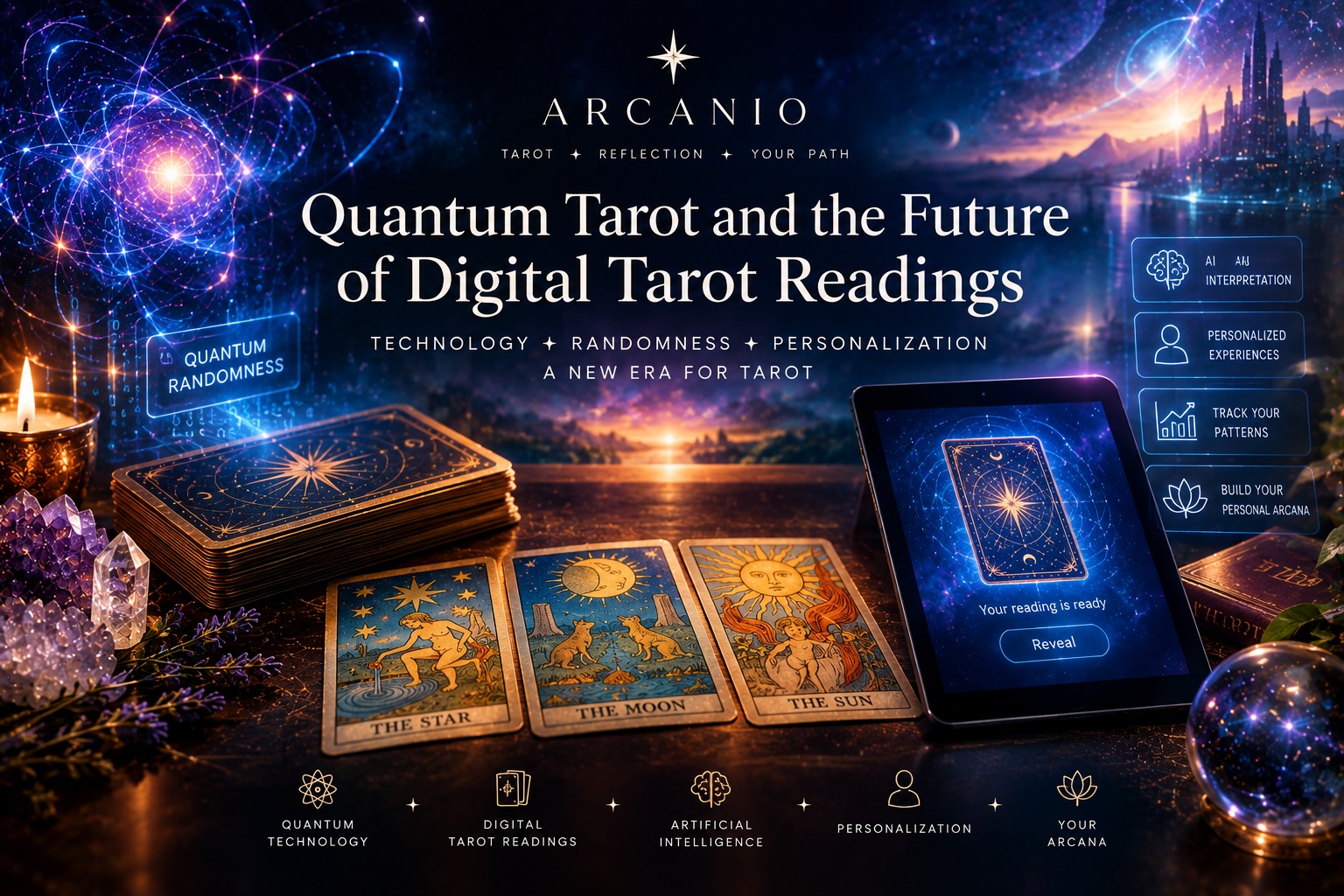
Tarot has always evolved with the culture around it. let's talk about Quantum Tarot and the Future and Future of Tarot here.
What began as a card game in Renaissance Europe eventually became associated with symbolism, spirituality, divination, personal reflection, and self-exploration. Today, tarot is undergoing another transformation as it moves from physical decks and face-to-face readings into websites, mobile applications, artificial intelligence, digital card systems, and increasingly sophisticated forms of randomness.
One of the most interesting developments in this transformation is Quantum Tarot.
Quantum Tarot brings together traditional tarot symbolism and modern technology, particularly digital randomness and, in some systems, quantum random number generation. Instead of physically shuffling a deck, a digital system can select cards algorithmically or through a physical source of quantum randomness.
This raises a fascinating question:
What will the future of digital tarot readings look like?
Will digital tarot eventually replace physical tarot cards?
Will artificial intelligence become part of tarot interpretation?
Could quantum randomness create a new generation of tarot readings?
And can technology preserve the mysterious, personal feeling that has made tarot fascinating for centuries?
The answer may not be about replacing traditional tarot.
The future could be about expanding it.
Platforms such as Arcanio represent this emerging direction: combining tarot, Arcana, digital experiences, personalization, and modern technology into a new way of exploring tarot.
What Is Quantum Tarot?
Quantum Tarot is a modern approach to tarot that connects tarot symbolism with concepts and technologies associated with quantum computing and quantum randomness.
The most important practical connection is randomness.
A traditional tarot reader shuffles a physical deck and selects cards.
A digital tarot system can use a pseudorandom number generator to determine which card appears.
A Quantum Tarot system can potentially use a quantum random number generator to introduce physical quantum randomness into that selection process.
This creates an interesting chain:
Quantum process → random number → tarot card → symbolic interpretation
The quantum system does not interpret the card.
It does not understand The Fool, The Moon, The Lovers, or The Tower.
It simply provides a mechanism for selecting an unpredictable result.
The meaning comes from the tarot system and, ultimately, from the person interpreting the result.
This distinction is important because Quantum Tarot should not be presented as scientific proof that tarot predicts the future.
Quantum mechanics is a scientific theory describing physical phenomena.
Tarot is a symbolic and interpretive tradition.
Quantum randomness can influence how a tarot card is selected, but it does not scientifically demonstrate that tarot cards can predict future events.
That separation allows Quantum Tarot to remain both technologically interesting and intellectually responsible.
If you want to explore the broader idea of modern digital tarot, you can also explore Arcanio's tarot and Arcana experience.
Why Is Digital Tarot Becoming More Important?
For most of tarot's history, a reading required physical cards.
You needed a deck.
You needed somewhere to shuffle.
You might need another person to perform the reading.
Today, that is no longer necessary.
A person can access a tarot reading from a computer or smartphone within seconds.
Digital tarot makes tarot:
More accessible
Easier to explore
Available at any time
Easier to personalize
Easier to combine with other technologies
Easier to document and revisit
This changes the relationship people have with tarot.
Instead of owning one physical deck, someone might explore several digital tarot systems.
Instead of visiting a reader once, someone can maintain a personal record of readings.
Instead of writing interpretations on paper, a digital platform can connect cards, meanings, questions, spreads, and personal patterns.
The next generation of tarot may therefore be less about simply putting a deck on a screen.
It may be about creating an entire digital tarot ecosystem.
For readers interested in moving from traditional tarot into a personalized online experience, Arcanio provides a natural starting point.
From Physical Cards to Digital Cards
The first major transition is simple:
Physical tarot → Digital tarot
A digital tarot deck reproduces the essential structure of a physical deck.
You can select a card.
You can view its artwork.
You can read its meaning.
You can place it into a spread.
But digital technology allows additional possibilities.
A digital tarot system can remember previous readings.
It can generate different spreads.
It can connect cards with personal questions.
It can create personalized profiles.
It can produce reports.
It can provide journaling prompts.
It can even use different methods of randomization.
This means digital tarot does not have to be a digital copy of physical tarot.
It can become a new format.
The Role of Quantum Randomness in Digital Tarot
Randomness is one of the most interesting technical components of digital tarot.
A computer can generate numbers using algorithms designed to appear random. These are generally called pseudorandom numbers because they are generated through deterministic processes.
Quantum random number generation takes a different approach.
Researchers can measure physical quantum phenomena to generate random values.
For example, quantum research from the National Institute of Standards and Technology (NIST) has demonstrated methods for generating and studying quantum randomness. This provides a useful scientific foundation for understanding why quantum randomness can be different from ordinary algorithmic pseudorandomness.
This creates a fascinating possibility for tarot.
Imagine a digital tarot platform with 78 cards.
Each card could correspond to a numerical range.
A quantum random number is generated.
That number determines the card.
The system might return:
The Star
The Star then becomes the starting point for the reading.
The technology determines selection.
Tarot provides symbolism.
The user creates meaning.
That is the fundamental concept behind quantum-enhanced digital tarot.
For readers interested specifically in the technical side of this concept, NIST's research on quantum random number generation provides useful scientific background.
Why Would Quantum Randomness Matter?
At first, quantum randomness may sound unnecessary.
After all, tarot cards have always been shuffled.
Why would a digital tarot platform need quantum technology?
The answer is not that quantum randomness makes tarot "more magical."
Instead, it provides an interesting technical method for introducing unpredictability.
Traditional tarot already depends on uncertainty.
You do not know which card will appear after shuffling.
Digital tarot needs to reproduce that uncertainty somehow.
A conventional system can use pseudorandom software.
A quantum system can use a physical quantum source.
The difference is therefore primarily about the mechanism of randomness rather than the symbolic meaning of the card.
For people interested in technology, this distinction makes Quantum Tarot especially compelling.
Quantum Tarot and the Future of Online Tarot Readings
Online tarot readings are likely to become more personalized.
Today's digital reading may simply display a card and its traditional meaning.
Future systems could potentially consider much more context.
A user might enter:
A question
A situation
A relationship topic
A career concern
A personal goal
A journal entry
A preferred spread
Previous readings
The system could then create a reading experience around that context.
For example, instead of simply generating three cards, a future platform could create:
Card 1 — Your current situation
Card 2 — What you may be overlooking
Card 3 — A perspective worth considering
The cards could then be combined with explanations, reflection questions, and a personal journal.
The reading becomes an interactive experience rather than a static result.
This is one reason modern platforms such as Arcanio can be viewed as part of the wider evolution from simple online card generators toward personalized digital tarot.
Artificial Intelligence and Digital Tarot
Artificial intelligence is another technology that could dramatically influence the future of digital tarot.
AI can already generate and analyze language, recognize patterns, summarize information, and create personalized responses.
This means an AI-assisted tarot platform could potentially help users explore the symbolism of cards in a conversational format.
Imagine drawing The Hermit.
Instead of simply reading a predefined paragraph, you could ask:
"How could The Hermit relate to the question I asked?"
The system could explain different traditional interpretations.
You could then ask:
"What does this card mean in a career context?"
Or:
"How does The Hermit compare with the other cards in my spread?"
This creates a conversational tarot experience.
However, AI should be treated as an interpretation tool rather than an unquestionable authority.
An AI-generated tarot interpretation is still an interpretation.
It does not magically transform symbolism into objective prediction.
The most interesting future may therefore be one where AI helps users explore possibilities rather than telling them what their future must be.
Quantum Tarot + AI + Personalization
The combination becomes even more interesting when quantum randomness, AI, and personalization are brought together.
Consider a future digital tarot system:
Step 1: Personal question
You enter a question or topic.
Step 2: Quantum randomness
A quantum random source selects the cards.
Step 3: Tarot symbolism
The system identifies the traditional meanings and relationships between the cards.
Step 4: Personal context
The system considers the question and selected spread.
Step 5: AI interpretation
An AI system explains several possible interpretations.
Step 6: Reflection
The user records their own reaction.
Step 7: Personal Arcana
The system remembers recurring cards, themes, and patterns.
This is much more than simply replacing a physical deck with a website.
It creates a personalized digital tarot environment.
You can explore Arcanio to see how tarot and personal Arcana can become part of a modern digital experience.
The Rise of Personal Arcana
One of the most exciting directions for digital tarot is personalization.
Traditional tarot is usually organized around the deck.
Digital tarot can increasingly be organized around the individual.
Instead of asking only:
"What card did I draw?"
you can begin asking:
"What patterns appear throughout my tarot journey?"
Perhaps The Star appears repeatedly.
Perhaps The Hermit appears whenever you ask about career decisions.
Perhaps The Lovers repeatedly appears when you ask about relationships.
A digital platform can potentially record these patterns.
This is where the idea of Personal Arcana becomes particularly interesting.
Your tarot experience can become a developing personal collection of symbols, interpretations, questions, and recurring themes.
Rather than treating every reading as an isolated event, digital tarot can help create continuity.
This is one of the areas where Arcanio's Personal Arcana experience fits naturally into the future of digital tarot.
Digital Tarot and Tarot Journaling
Tarot journaling is another area where digital technology can make a major difference.
Traditionally, someone might write a reading in a notebook:
Date: October 7
Question: What should I focus on today?
Card: The Magician
Interpretation: Creativity and action.
A digital system could turn this into a structured archive.
Over time, hundreds of readings could become searchable.
You could explore questions such as:
Which cards appear most often?
Which cards appear in career readings?
Which cards appear in relationship readings?
Which cards appeared during important periods?
How did I interpret a card six months ago?
Has my interpretation changed?
This transforms tarot journaling into a personal symbolic database.
The future of tarot may therefore involve not only readings but also long-term personal reflection.
One Card Tarot in the Digital Age
One Card Tarot is particularly well suited to digital platforms.
A single card can be generated instantly.
There is no need to shuffle a physical deck.
A person can receive a daily card within seconds.
But future systems could make the experience more meaningful.
Instead of simply saying:
Today's card: The Sun
a digital platform might provide:
Today's card: The Sun
Reflection: What currently gives you energy?
Journal prompt: Where are you experiencing clarity?
Follow-up: Has this theme appeared in previous readings?
This transforms a simple card draw into a daily ritual.
Quantum randomness could determine the card.
AI could help explain traditional symbolism.
Personal Arcana could record the result.
The user provides the final reflection.
For a modern digital tarot experience, visit Arcanio and explore how tarot can become part of a broader personal Arcana journey.
Three Card Tarot in the Future
Three-card readings are also likely to become more interactive.
A digital platform could offer dozens of different three-card structures.
For example:
Past — Present — Future
A classic structure for exploring a situation over time.
Situation — Challenge — Advice
A practical structure for examining a current problem.
Mind — Emotion — Action
A reflective structure for exploring different aspects of an experience.
What I Know — What I Don't Know — What to Explore
A structure particularly suited to personal reflection.
The system could randomly select the cards while dynamically explaining how the positions interact.
This could make digital tarot much more engaging than simply displaying three card meanings on a screen.
Will Digital Tarot Replace Physical Tarot?
Probably not.
The history of technology suggests that new formats do not always destroy old ones.
Digital books did not eliminate physical books.
Streaming did not eliminate every form of live music.
Digital photography did not completely eliminate the desire for printed photographs.
Likewise, digital tarot does not necessarily need to eliminate physical tarot.
Physical decks offer something digital systems cannot perfectly reproduce:
tactile experience.
There is something unique about touching a deck, shuffling it, looking at the artwork, and physically placing cards on a table.
For many people, this is part of the ritual.
Digital tarot offers different advantages:
Accessibility.
Personalization.
Speed.
Data.
Interactivity.
Experimentation.
The future is likely to contain both.
What Will Make Future Digital Tarot Better?
Several developments could shape the next generation of digital tarot.
1. Better Randomness
Digital tarot systems may increasingly experiment with high-quality physical and quantum randomness.
2. Better Personalization
Readings may become increasingly connected to an individual's history and preferences.
3. Conversational AI
Users may be able to discuss cards and spreads naturally instead of reading static descriptions.
4. Better Tarot Visualization
Digital cards could become interactive, animated, immersive, or spatial.
5. Personal Arcana
Users may maintain long-term symbolic profiles based on their tarot experiences.
6. Digital Tarot Journals
Readings could automatically become part of an organized personal journal.
7. More Sophisticated Spreads
Instead of a fixed selection of popular spreads, digital platforms could dynamically create layouts based on the user's question.
8. Multimodal Experiences
Future readings could combine text, images, audio, animation, and interactive elements.
The result could feel less like using a tarot website and more like entering a personal symbolic environment.
What Quantum Tarot Does Not Mean
As Quantum Tarot becomes more popular, it is important to avoid exaggerating the science.
Quantum Tarot does not automatically mean:
Quantum physics proves tarot.
Tarot cards are quantum objects.
Quantum mechanics predicts your future.
Quantum randomness creates supernatural powers.
AI can know your destiny.
A quantum-generated card is objectively more meaningful than a traditionally shuffled card.
These claims go beyond what the technology supports.
The scientifically meaningful statement is much simpler:
Quantum processes can be used to generate physically unpredictable random values, and those values can be used to select tarot cards.
What the card means is a different question.
That belongs to tarot symbolism, interpretation, culture, psychology, spirituality, and personal reflection.
Keeping these concepts separate makes digital tarot more credible.
Tarot's Long History of Technological Change
It is easy to think of tarot as something that has remained unchanged for hundreds of years.
It has not.
The Metropolitan Museum of Art explains that the earliest documented references to tarot date to the 1440s and 1450s in northern Italian cities. Early tarot was associated with card games, while the association with fortune-telling developed much later.
This history is useful because it shows that tarot itself has changed over time.
The transition from physical cards to digital cards is simply another transformation.
The technology changes.
The imagery evolves.
The interpretations change.
The underlying human desire to explore uncertainty and meaning remains.
For readers who want to explore more about the historical development of tarot, the Metropolitan Museum of Art's history of tarot is a useful reference.
Can Technology Make Tarot More Personal?
Potentially, yes.
A physical deck provides the same 78 cards to everyone.
A digital platform can potentially create a personalized environment around those cards.
Imagine a user whose digital tarot profile contains:
Favorite cards
Previous readings
Recurring cards
Personal interpretations
Journal entries
Frequently used spreads
Personal Arcana
Questions explored over time
The experience becomes unique to that person.
Instead of simply asking:
"What does The Moon mean?"
the user might eventually ask:
"What has The Moon meant throughout my own tarot journey?"
That is a much more personal question.
Arcanio is designed around this broader idea of exploring tarot and personal Arcana through a modern digital experience.
Arcanio and the Future of Digital Tarot
This is the direction that makes modern tarot platforms particularly interesting.
Arcanio is built around the idea of combining tarot and Arcana with a modern digital experience.
Rather than treating tarot as nothing more than a card generator, the future can connect:
Tarot
Arcana
Readings
Spreads
Personalization
Digital reports
Reflection
Technology
This creates a broader tarot experience.
For someone discovering Quantum Tarot, the journey does not have to stop after one randomly selected card.
A reading can lead to another reading.
A card can lead to a spread.
A spread can lead to journaling.
Repeated readings can lead to Personal Arcana.
Personal Arcana can become a longer-term way of exploring recurring symbols and themes.
That interconnected experience is where digital tarot has the potential to become significantly more powerful as a user experience.
The Future May Be Hybrid
The most exciting future for tarot may not be completely digital.
It may be hybrid.
Imagine sitting at a table with a physical tarot deck while using a digital system to record the reading.
Or using a digital system to generate a random card before interpreting it with a physical deck.
Or combining traditional tarot artwork with quantum-generated randomness.
Or keeping a physical tarot journal while using an AI system to organize recurring themes.
Technology does not have to remove the ritual.
It can support the ritual.
That may be the most natural future for tarot.
Quantum Tarot and the Human Imagination
Technology can generate numbers.
It can display images.
It can store information.
It can analyze language.
But technology does not automatically create personal meaning.
That part remains human.
A card such as The Star can represent hope, renewal, inspiration, or healing depending on the tradition and context.
The meaning becomes richer when the person asks:
"Why does this symbol matter to me right now?"
This is why the future of digital tarot should not be judged only by how sophisticated its technology becomes.
The better question is:
Does the technology help people engage more deeply with the symbolism?
If it does, then technology can become part of the tarot experience without replacing its human core.
Quantum Tarot and the Future of Digital Tarot Readings
The future of digital tarot is likely to be more interactive, more personalized, and more technologically sophisticated.
Quantum randomness may provide new ways of selecting cards.
Artificial intelligence may provide conversational interpretations.
Digital systems may remember readings and identify recurring themes.
Personal Arcana may create a long-term symbolic profile.
Interactive spreads may adapt to individual questions.
Digital reports may turn readings into lasting records.
But the essential experience may remain surprisingly familiar.
A person asks a question.
A card appears.
A symbol catches their attention.
They interpret it.
They reflect.
And something about the image helps them look at their situation differently.
That is the enduring power of tarot.
Technology can change the method.
It can change the interface.
It can change the randomness.
It can change the way information is delivered.
But it does not have to change the fundamental human experience of searching for meaning.
Final Thoughts
Quantum Tarot and the future of digital tarot readings represent an exciting meeting point between ancient symbolism and modern technology.
Quantum randomness can provide a sophisticated source of unpredictable card selection.
Artificial intelligence can create conversational and personalized interpretation tools.
Digital platforms can preserve reading histories, create personal journals, connect recurring symbols, and develop Personal Arcana experiences.
None of this scientifically proves tarot or turns a digital reading into a guaranteed prediction of the future.
Instead, it creates new possibilities for how people can interact with tarot.
Traditional tarot gave us the cards.
Digital tarot gave us accessibility.
AI can give us conversation.
Quantum technology can give us new approaches to randomness.
And the individual gives the reading its personal meaning.
That may ultimately be the future of tarot:
not tarot versus technology, but tarot enhanced by technology.
Frequently Asked Questions
What is Quantum Tarot?
Quantum Tarot is a modern approach to tarot that combines tarot symbolism with digital technology and, in some systems, quantum randomness for selecting cards.
Is Quantum Tarot scientifically proven?
Quantum randomness itself is scientifically established, but tarot as a predictive or divinatory system has not been scientifically proven. Quantum technology can provide random card selection; it does not prove that tarot predicts the future.
What is the future of digital tarot?
Digital tarot is likely to become more personalized and interactive, potentially combining AI, sophisticated randomness, digital journaling, adaptive spreads, personal profiles, and personalized Arcana systems.
Will AI replace tarot readers?
AI may become a useful tool for explaining symbolism and generating personalized interpretations, but it does not necessarily replace the human connection, intuition, experience, and personal relationship involved in traditional tarot reading.
Can quantum randomness be used to select tarot cards?
Yes. A quantum random number can be mapped to a tarot deck so that the resulting number determines which card is selected.
Is quantum tarot more accurate than traditional tarot?
There is no scientific evidence that quantum-generated tarot cards are more accurate at predicting the future than traditionally shuffled cards. Quantum randomness changes the selection mechanism, not the scientific status of tarot interpretation.
Can digital tarot become personalized?
Yes. Digital systems can potentially remember readings, recurring cards, interpretations, spreads, journal entries, and other information to create a more personalized tarot experience.
What is Personal Arcana?
Personal Arcana can refer to an individual's personalized relationship with tarot symbolism, including recurring cards, themes, interpretations, and other elements of their tarot journey. Digital platforms can help organize these experiences over time.
Can Quantum Tarot and Traditional Tarot work together?
Absolutely. Quantum randomness can be used to select cards while traditional tarot symbolism, physical decks, established meanings, and traditional spreads remain part of the reading experience.
Where can I explore modern tarot and Arcana?
Explore Arcanio to discover a modern digital approach to tarot, readings, symbolism, and Personal Arcana.

The conversation
Be the first to say something
Comments are open to anyone with an account — it keeps the thread honest and your comments yours. It takes a moment and the weekly reading comes with it.