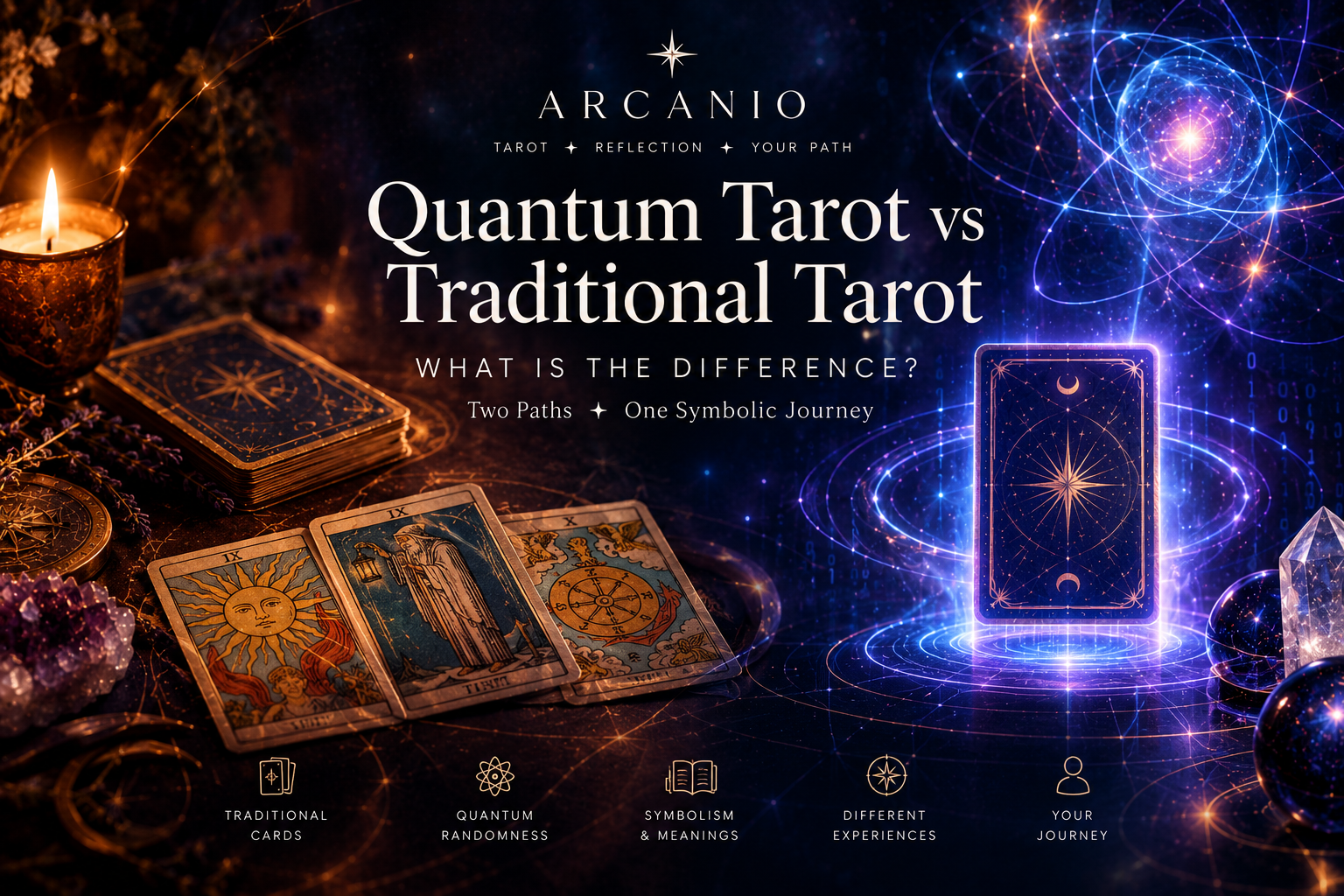
Tarot has been used for centuries as a symbolic system for reflection, storytelling, interpretation, and, in modern practice, divination. Today, however, tarot is no longer limited to physical cards and traditional readings. Digital platforms, random number generators, artificial intelligence, and quantum technology are creating new ways to experience tarot. we will write about Quantum Tarot vs Traditional Tarot readings.
This has led to an interesting question:
What is the difference between Quantum Tarot and Traditional Tarot?
The comparison between Quantum Tarot vs Traditional Tarot is not simply about old cards versus new technology. It is about two different approaches to selecting, experiencing, and interpreting tarot cards.
Traditional Tarot generally focuses on established tarot decks, familiar spreads, traditional meanings, and the relationship between the reader, the cards, and the person receiving the reading. Quantum Tarot introduces a technological layer, particularly through quantum randomness, digital card selection, and ideas inspired by modern physics.
But there is an important distinction.
Quantum physics does not scientifically prove tarot, divination, psychic abilities, or the predictive power of tarot cards.
Instead, quantum technology can provide an interesting method for generating unpredictable numbers that can be mapped to tarot cards. The interpretation remains symbolic and human.
For people interested in both ancient symbolism and modern technology, this creates a fascinating new space.
In this guide, we will explore Quantum Tarot vs Traditional Tarot, how each approach works, what they have in common, the role of randomness, and how modern platforms such as Arcanio are creating new ways to explore tarot and personal Arcana.
What Is Traditional Tarot?
Traditional Tarot refers broadly to tarot practices that use established tarot cards, traditional symbolism, recognized card meanings, and established tarot spreads.
A typical tarot deck contains 78 cards:
- 22 Major Arcana cards
- 56 Minor Arcana cards
The Major Arcana includes cards such as The Fool, The Magician, The High Priestess, The Lovers, Death, The Star, The Moon, The Sun, and The World.
The Minor Arcana is divided into four suits, commonly represented as:
- Cups
- Swords
- Wands
- Pentacles
Traditional tarot readings can involve one card, three cards, or much larger spreads.
For example, a reader might use a One Card Tarot reading for a simple daily reflection or a Three Card Tarot Spread to explore a situation through three different positions.
One of the most famous three-card formats is the Past Present Future Tarot Spread, where each card represents a different stage of a situation.
Traditional Tarot is therefore more than simply drawing a card. It is a system of symbols and relationships.
The meaning of a card depends not only on the card itself but also on its position, surrounding cards, the question being considered, and the interpretation of the reader.
Where Did Traditional Tarot Come From?
The history of tarot is more complicated than many modern descriptions suggest.
The earliest documented references to tarot date to the 1440s and 1450s in northern Italian cities including Venice, Milan, Florence, and Urbino.
Early tarot was primarily associated with card games rather than modern fortune-telling.
The Metropolitan Museum of Art explains that early tarot decks combined four Italian suits with additional trump cards and a Fool. The modern association between tarot and fortune-telling became prominent much later, particularly during the nineteenth century.
This distinction is important when comparing Quantum Tarot vs Traditional Tarot.
Traditional tarot is not necessarily an ancient predictive technology. Its history developed through playing-card culture, artistic symbolism, European history, esoteric traditions, and later divinatory practices.
Today, tarot can be approached in many different ways.
Some people view it as divination.
Others use it for meditation, journaling, creativity, self-reflection, storytelling, or personal exploration.
What Is Quantum Tarot?
Quantum Tarot is a modern approach to tarot that combines tarot symbolism with digital technology and concepts inspired by quantum mechanics.
The word "quantum" can refer to several different ideas in modern tarot systems.
It may describe:
- Quantum random number generation
- Digital randomness
- Computational tarot selection
- Quantum-inspired symbolism
- Technology-based tarot readings
- A philosophical connection between uncertainty and tarot
The most technically meaningful connection is quantum randomness.
Quantum mechanics allows researchers to create systems whose measurement outcomes are fundamentally unpredictable in ways that differ from ordinary algorithmic pseudorandomness.
Organizations such as NIST have demonstrated quantum methods for generating random numbers using quantum phenomena.
A Quantum Tarot system can potentially use such random information to determine which tarot card is selected.
For example, imagine a system assigning numbers to the 78 tarot cards.
A random result could determine:
Card 1 → The Fool
Card 2 → The Magician
Card 3 → The High Priestess
and so on.
The quantum system does not "understand" The Fool or The Magician.
It simply produces an unpredictable selection.
The symbolic interpretation happens afterward.
This is one of the most important ideas to understand when discussing Quantum Tarot vs Traditional Tarot.
Quantum Tarot vs Traditional Tarot: The Main Difference
The simplest distinction is this:
Traditional Tarot relies primarily on traditional card selection and established reading practices, while Quantum Tarot can introduce quantum or advanced digital randomness into the card-selection process.
However, the difference becomes more interesting when we look at the entire reading experience.
| Feature | Traditional Tarot | Quantum Tarot |
|---|---|---|
| Physical cards | Common | Optional |
| Digital cards | Optional | Common |
| Traditional symbolism | Yes | Yes |
| Established tarot meanings | Yes | Usually |
| Human interpretation | Central | Central |
| Random card selection | Yes | Yes |
| Quantum randomness | Usually not | May be used |
| Online readings | Possible | Common |
| Technology | Optional | Important |
| Personal reflection | Yes | Yes |
| Scientific proof of divination | No | No |
The important point is that Quantum Tarot does not necessarily replace traditional tarot.
Instead, it can be viewed as a technological evolution of how cards are selected and experienced.
How Does a Traditional Tarot Reading Work?
In a traditional tarot reading, the cards are usually shuffled physically.
The reader may then:
- Focus on a question.
- Shuffle the deck.
- Cut the deck.
- Draw one or more cards.
- Place the cards into a spread.
- Interpret the symbolism.
- Connect the cards to the question.
Different readers have different rituals.
Some shuffle until they feel ready.
Some ask the person receiving the reading to shuffle.
Some spread the cards across a table and select cards intuitively.
Others use a specific number of shuffles.
There is no single universal procedure.
The strength of traditional tarot often comes from its physical and psychological experience.
Holding the cards, seeing the artwork, physically shuffling the deck, and placing each card into a spread can create a strong ritual.
For many people, that ritual is part of the meaning.
How Does a Quantum Tarot Reading Work?
A Quantum Tarot reading can move the card-selection process into a digital environment.
Imagine that every tarot card has been assigned a unique numerical value.
A system requests a random number.
That number is mapped to one of the cards.
The selected card becomes part of the reading.
If the system uses a quantum random source, the random value can originate from a physical quantum process rather than only from a conventional software algorithm.
This creates a fascinating combination:
Ancient symbolism + modern computation + quantum randomness.
The technology determines selection.
The tarot system provides symbolism.
The human provides interpretation.
The result is a modern tarot experience without requiring the physical act of shuffling cards.
Is Quantum Tarot Actually Quantum Physics?
This is where it is important to separate technology from spiritual interpretation.
Quantum Tarot can use technology based on quantum randomness.
That does not mean quantum physics proves tarot.
Quantum mechanics is a highly successful scientific theory describing physical phenomena at very small scales.
Tarot is a symbolic and interpretive system.
There is currently no scientific basis for claiming that quantum mechanics demonstrates that tarot cards can predict future events.
Therefore, responsible Quantum Tarot should avoid claims such as:
"Quantum physics proves tarot."
or:
"Quantum mechanics proves that tarot cards know your future."
Those statements go beyond what the science establishes.
A more accurate statement is:
Quantum technology can provide a source of physical randomness for selecting tarot cards, while tarot interpretation remains symbolic and subjective.
That distinction makes Quantum Tarot more interesting, not less.
Why Does Randomness Matter in Tarot?
Randomness has always been important to card-based systems.
Whenever cards are shuffled, the order of the cards changes.
A reader does not normally know which card will appear next.
That uncertainty is part of the experience.
In digital tarot, however, there is a technical question:
How should a computer choose the card?
A simple digital system could use a pseudorandom number generator.
This is common in software.
A more advanced system could use physical randomness.
A Quantum Tarot platform can take this idea even further by using quantum-generated randomness.
This creates a fascinating conceptual connection.
Traditional tarot uses the unpredictability of physical cards.
Digital tarot uses computational randomness.
Quantum Tarot can use quantum randomness.
The symbolic experience can remain similar even though the mechanism behind card selection changes.
Quantum Tarot vs Traditional Tarot: Is One More Accurate?
Not necessarily.
The method used to select a card does not automatically make the interpretation more accurate.
A quantum random number generator can generate unpredictable numbers.
It cannot determine what The Tower means in your life.
It cannot know whether you should change careers.
It cannot scientifically predict whether a relationship will succeed.
The interpretation remains dependent on the symbolic system and the person engaging with it.
This is why it may be more useful to ask:
Which tarot experience helps you reflect more effectively?
rather than:
Which tarot system is scientifically more accurate?
Traditional Tarot may appeal to people who enjoy physical cards and established rituals.
Quantum Tarot may appeal to people who enjoy technology, digital experiences, randomness, and the philosophical relationship between uncertainty and symbolism.
Neither needs to eliminate the other.
Traditional Tarot and the Human Element
One of the strongest aspects of traditional tarot is the human experience.
A skilled tarot reader may consider:
- The question
- The emotional context
- Card relationships
- Symbolism
- Numerology
- Reversed cards
- Spread positions
- Visual details
- Personal associations
The reader creates a narrative from these elements.
This is why two readers can look at exactly the same three cards and produce different interpretations.
The cards provide symbols.
The interpretation creates meaning.
Quantum Tarot does not have to change this.
A digital system can select the cards while the person remains responsible for reflection and interpretation.
Quantum Tarot and One Card Readings
One of the easiest ways to understand Quantum Tarot is through a one-card reading.
A system selects a single card.
For example:
The Hermit
Instead of treating the result as a guaranteed prediction, you might ask:
"What does The Hermit make me think about my current situation?"
You might associate the card with:
- Solitude
- Reflection
- Learning
- Patience
- Inner guidance
- Stepping away from noise
The important part is not necessarily whether the card "knows" something.
The value may come from what the symbol causes you to notice.
This makes Quantum Tarot particularly interesting for daily reflection.
A random card can introduce an unexpected perspective into your thinking.
You can explore this approach further through a One Card Tarot reading and use the result as a journaling prompt.
Quantum Tarot and Three Card Spreads
Three-card spreads are another natural application.
A system can randomly select three cards.
The cards can then be assigned positions such as:
Card One — Past
Card Two — Present
Card Three — Future
This creates the classic Past Present Future Tarot Spread.
Another option might be:
Situation — Challenge — Advice
or:
Mind — Body — Spirit
or:
What I know — What I don't know — What I should consider
The random selection creates the starting point.
The spread provides structure.
The symbolism provides material for reflection.
This is one of the strongest similarities between traditional and Quantum Tarot.
The technology may change the selection mechanism, but the basic interpretive process can remain familiar.
Quantum Tarot vs Traditional Tarot for Online Readings
The difference becomes especially noticeable when tarot moves online.
Traditional tarot was designed around physical cards.
Online tarot requires a digital representation.
A website can reproduce the card deck, spreads, meanings, and interpretation system.
Quantum Tarot can add another layer by introducing advanced random selection.
For someone using an online tarot platform, this can create a completely different experience from visiting a physical tarot reader.
Instead of:
Physical deck → shuffle → card
the experience might become:
Digital system → quantum randomness → card → interpretation
The interface becomes part of the ritual.
This is where modern tarot platforms such as Arcanio fit naturally into the conversation.
Quantum Tarot and Personal Arcana
Tarot becomes even more interesting when it moves beyond individual readings.
A person's relationship with tarot can involve recurring symbols, favorite cards, personality themes, life questions, and personal interpretations.
This creates the idea of Personal Arcana.
Instead of asking only:
"What card did I draw today?"
you can ask:
"What patterns keep appearing in my tarot journey?"
A modern digital tarot platform can organize these experiences into a personalized profile.
This can include:
- Personal Arcana
- Card meanings
- Tarot readings
- Tarot spreads
- Symbolic themes
- Personalized results
- Digital reports
- Reflection prompts
For a platform like Arcanio, this creates a bridge between traditional tarot knowledge and modern digital personalization.
The goal is not necessarily to replace the traditional tarot experience.
It is to expand it.
What Traditional Tarot Does Better
Traditional Tarot has several qualities that technology cannot perfectly reproduce.
Physical Ritual
Shuffling a physical deck can be calming and immersive.
Artwork
Physical tarot cards can be beautiful objects.
Human Connection
A live reader can respond to another person's emotions and reactions.
Established Tradition
Traditional tarot connects modern readers with centuries of card culture and symbolism.
Intuitive Experience
Some readers enjoy selecting cards based on physical sensation or intuition.
For these reasons, traditional tarot will likely remain important even as digital tarot evolves.
What Quantum Tarot Does Differently
Quantum Tarot offers a different set of possibilities.
Technological Randomness
Quantum systems can provide a sophisticated source of randomness.
Digital Accessibility
A reading can be performed anywhere with access to the platform.
Repeatability
Digital systems can document readings and results.
Personalization
Software can create personalized profiles and reading experiences.
New Forms of Tarot
Technology makes it possible to create tarot experiences that would be difficult with a physical deck.
This might include dynamic spreads, personalized card systems, digital Arcana profiles, and experimental approaches to randomness.
Does Quantum Tarot Replace Traditional Tarot?
No.
A better way to think about Quantum Tarot vs Traditional Tarot is evolution rather than replacement.
Traditional Tarot provides the foundation:
Cards + symbolism + spreads + interpretation
Quantum Tarot adds:
Technology + digital randomness + computational systems
The two approaches can coexist.
A tarot enthusiast could use a physical deck in the morning and explore a digital Quantum Tarot reading in the evening.
The experience does not have to be either/or.
Quantum Tarot vs Traditional Tarot: Which Should You Try?
The answer depends on what you want from tarot.
Choose Traditional Tarot if you enjoy:
- Physical tarot decks
- Shuffling cards
- Tarot rituals
- Working with a human reader
- Traditional symbolism
- Established tarot spreads
- The physical artwork of tarot cards
Try Quantum Tarot if you enjoy:
- Technology
- Digital tarot
- Randomness
- Quantum concepts
- Experimental approaches
- Online readings
- Personalized digital experiences
- Exploring the relationship between science and symbolism
You can also explore both.
In fact, comparing the results from a traditional deck and a Quantum Tarot system could become an interesting personal experiment.
Ask the same question.
Draw one card physically.
Then generate one card digitally.
Compare your reactions.
Which card makes you think differently?
Which image creates the stronger association?
Which reading gives you a more useful perspective?
The experiment itself can become part of your tarot practice.
A Responsible Way to Think About Quantum Tarot
The most useful approach is to maintain curiosity without confusing symbolism with scientific evidence.
Quantum randomness is a real scientific concept.
Quantum random number generators are real technologies.
Tarot symbolism is real as a cultural and interpretive tradition.
But these facts do not automatically establish that tarot predicts the future through quantum mechanics.
You can enjoy the mystery without making scientific claims that cannot be supported.
This distinction also makes Quantum Tarot more intellectually interesting.
It allows technology and symbolism to meet without pretending that they are the same thing.
The Future of Tarot
Tarot has already evolved many times.
It moved from physical card games into artistic traditions.
It later became connected with occult and fortune-telling practices.
Today, tarot exists in books, apps, websites, videos, digital communities, online readings, personalized systems, and interactive platforms.
Quantum Tarot represents another stage of that evolution.
Future tarot systems could potentially combine:
- Quantum randomness
- Artificial intelligence
- Personalized Arcana
- Digital card libraries
- Interactive spreads
- Voice interfaces
- Journaling
- Personalized tarot reports
- Advanced symbolic systems
The central question may remain unchanged:
What does this symbol mean to me?
Technology can change how the card appears.
It can change how the card is selected.
It can change how the reading is delivered.
But interpretation remains at the center of the experience.
Quantum Tarot vs Traditional Tarot: Final Comparison
At first glance, Quantum Tarot and Traditional Tarot may seem completely different.
One feels ancient.
The other feels futuristic.
One uses physical cards.
The other may use software and quantum randomness.
But underneath those differences, they share an important foundation.
Both use symbols to encourage interpretation.
Both can use random card selection.
Both can use structured spreads.
Both can become tools for reflection.
Both depend on the meaning a person creates from the cards.
The biggest difference is the mechanism behind the experience.
Traditional Tarot generally relies on physical cards, established rituals, and human interaction.
Quantum Tarot can introduce digital systems and quantum-generated randomness into the selection process.
That makes Quantum Tarot less of a replacement for traditional tarot and more of a modern experiment in how tarot can evolve.
Explore Quantum Tarot With Arcanio
If you are interested in the intersection between tarot, technology, randomness, and personal symbolism, Arcanio provides a modern way to explore the world of Tarot and Arcana.
You can explore tarot concepts, readings, spreads, and personalized Arcana experiences through a digital environment designed around modern tarot exploration.
You can also connect this article with related topics such as Quantum Tarot, Quantum Randomness and Tarot, One Card Tarot, Three Card Tarot Spread, and Past Present Future Tarot Spread to create a deeper tarot learning journey.
The future of tarot does not necessarily require choosing between ancient symbolism and modern technology.
Perhaps the more interesting possibility is bringing them together.
Traditional Tarot gives us the symbols.
Technology gives us new ways to experience them.
Quantum randomness gives us a new way to introduce uncertainty into the selection process.
And ultimately, you create the meaning.
Frequently Asked Questions
What is the difference between Quantum Tarot and Traditional Tarot?
Traditional Tarot generally uses physical cards, established tarot symbolism, and traditional reading methods. Quantum Tarot may use digital technology and quantum randomness to select cards while retaining traditional tarot symbolism and interpretation.
Is Quantum Tarot scientifically proven?
Quantum randomness is scientifically established, but Quantum Tarot as a divination or predictive system is not scientifically proven. Quantum technology can provide random selection; it does not establish that tarot can predict future events.
Does Quantum Tarot use real quantum physics?
A Quantum Tarot system can use quantum random number generation, which relies on physical quantum processes. However, not every digital tarot system described as "quantum" necessarily uses a genuine quantum random source.
Is Traditional Tarot more accurate than Quantum Tarot?
There is no scientific basis for saying that either method is inherently more accurate at predicting the future. The two approaches mainly differ in how cards are selected and how the experience is delivered.
Can Quantum Tarot use traditional tarot cards?
Yes. Quantum technology can be used simply to determine which card should be selected from a traditional tarot deck or digital representation. The underlying card meanings and symbolism can remain traditional.
Can I use Quantum Tarot for a three-card reading?
Yes. A Quantum Tarot system can randomly select three cards and assign them to positions such as Past, Present, and Future, Situation, Challenge, and Advice, or other three-card spreads.
Is quantum randomness truly random?
Quantum random number generation is based on physical quantum processes whose outcomes can have intrinsic unpredictability. Scientific organizations such as NIST have developed and studied quantum methods for generating and certifying randomness.
Does quantum randomness make a tarot reading more powerful?
Not scientifically. Quantum randomness can make the card-selection mechanism more physically unpredictable, but it does not scientifically make the interpretation more accurate or prove that the cards predict the future.
Can Quantum Tarot replace a traditional tarot reader?
It can provide a different experience, especially for people who enjoy digital tools, but it does not necessarily replace the human connection and interpretation offered by a traditional tarot reader.
Where can I explore modern tarot and personal Arcana?
Arcanio is a modern tarot and Arcana platform designed to combine tarot exploration, digital readings, symbolism, and personalized experiences.

The conversation
Be the first to say something
Comments are open to anyone with an account — it keeps the thread honest and your comments yours. It takes a moment and the weekly reading comes with it.