Sometimes, you do not need a complicated tarot spread to explore an important question. A single card can provide a simple point of focus, a new perspective, or a theme to reflect on throughout your day. That is where One Card Tarot comes in.
A one card tarot reading is one of the simplest ways to work with tarot. Instead of using a large spread with multiple positions, you draw just one card and explore what its imagery, symbolism, and traditional meaning might bring to your question.
For beginners, One Card Tarot can be an excellent way to learn the cards without feeling overwhelmed. For experienced readers, it can be a useful daily practice when there is one particular idea, question, or situation you want to explore.
You can use a one-card reading in the morning, before making a decision, when starting a new project, or whenever you simply want a moment of reflection.
If you want to try a tarot experience online, you can also explore Arcanio and discover a visual approach to tarot and personal Arcana.
What Is One Card Tarot?
One Card Tarot is a tarot reading method that uses a single card to answer or explore one focused question.
The basic process is simple:
Think about a question or intention.
Shuffle your tarot deck.
Draw one card.
Study the card.
Consider its traditional meaning.
Connect the card to your question.
Reflect on what the card may be showing you.
Unlike larger spreads, there are no multiple positions to remember.
One card can represent a theme, lesson, question, opportunity, challenge, or energy to consider.
For example, you might ask:
"What should I focus on today?"
You then draw one card and use it as a prompt for reflection.
You can also ask:
"What should I understand about my current situation?"
Or:
"What energy should I pay attention to?"
The goal is not necessarily to receive a complicated answer. Instead, the single card gives you one central idea to explore.
Why Try a One Card Tarot Reading?
The biggest advantage of a one card tarot reading is its simplicity.
With a larger tarot spread, you may need to understand several positions and interpret relationships between multiple cards.
With one card, you can concentrate completely on a single image.
This makes One Card Tarot particularly useful for beginners.
It can also be helpful when you are short on time. A one-card reading can take only a few minutes, making it easy to incorporate into a daily routine.
Another benefit is that one card encourages deeper observation.
Instead of immediately searching for ten different card meanings, you can spend time looking at the image.
What catches your attention?
What emotions does the card create?
What symbols stand out?
What part of the card seems most relevant to your question?
These observations can become an important part of your interpretation.
How to Do a One Card Tarot Reading
A one-card reading does not require an elaborate setup.
You can perform one almost anywhere.
Step 1: Choose a Question
Start with one clear question.
Your question can be practical, emotional, creative, or simply reflective.
Some examples include:
What should I focus on today?
What should I understand about my current situation?
What lesson should I pay attention to?
What energy surrounds this situation?
What should I consider before making this decision?
What can I learn from this experience?
What should I explore today?
Try not to ask several unrelated questions at once.
One card works best when it has one clear subject.
Step 2: Take a Moment to Focus
Before drawing your card, pause for a moment.
Think about your question.
You do not need a complicated ritual.
Simply giving yourself a few quiet seconds can help you approach the reading with more attention.
Step 3: Shuffle the Cards
Shuffle your tarot deck using whatever method feels natural.
There is no universally required way to shuffle.
Some people shuffle several times, while others cut the deck or spread the cards before selecting one.
Choose a method that helps you focus.
Step 4: Draw One Card
Draw a single card.
Place it somewhere you can see it clearly.
Before looking up the traditional meaning, spend a few moments examining the card.
Look at its colors, figures, symbols, direction, background, and overall atmosphere.
Step 5: Connect the Card to Your Question
Now ask:
How does this card relate to what I asked?
This is an important part of One Card Tarot.
A card does not have one meaning that applies identically to every situation.
The question provides context.
For example, a card associated with movement could have a different interpretation in a career reading than in a personal-growth reading.
The card and the question should be considered together.
One Card Tarot for Daily Guidance
One of the most popular ways to use One Card Tarot is as a daily practice.
A morning one-card reading can give you a theme to think about during the day.
You might ask:
"What should I be mindful of today?"
Then draw one card.
The card does not have to predict what will happen.
Instead, you can treat it as a reflection prompt.
If the card represents patience, for example, you might pay more attention to situations where rushing could create unnecessary problems.
If the card represents communication, you might become more conscious of how you express yourself.
If the card represents change, you might reflect on areas of your life where you are adapting to something new.
This approach makes a daily tarot card less about prediction and more about awareness.
One Card Tarot for Love and Relationships
A single tarot card can also be used to reflect on relationships.
Instead of asking a question about another person's private thoughts, consider questions that focus on your own perspective.
For example:
"What should I understand about my relationship right now?"
Or:
"What should I pay attention to in my relationship?"
Or:
"What can I learn about my approach to love?"
A single card can provide a theme for reflection.
If you draw a card associated with communication, you might think about whether honest conversation deserves more attention.
If you draw a card associated with boundaries, you might reflect on whether your personal limits are being respected.
If you draw a card associated with partnership, you might consider the importance of cooperation and mutual understanding.
The card becomes a starting point for thinking rather than a substitute for communication with another person.
One Card Tarot for Career
Career questions are another excellent use for a one-card reading.
You could ask:
"What should I focus on in my career right now?"
Or:
"What should I understand about my current professional situation?"
Or:
"What quality could help me move forward?"
The card can then act as a prompt.
For example, a card associated with persistence could encourage you to consider the value of consistent effort.
A card associated with creativity could encourage you to explore a different approach to a project.
A card associated with planning could remind you to consider your long-term goals.
The reading does not need to provide a specific career prediction to be useful.
Sometimes a single perspective is enough to help you reconsider a situation.
One Card Tarot for Personal Growth
One Card Tarot can be particularly valuable as a personal reflection practice.
Try questions such as:
"What am I learning right now?"
"What should I release?"
"What quality should I develop?"
"What should I become more aware of?"
These questions shift the focus away from predicting external events and toward understanding yourself.
You can even keep a tarot journal.
Each day, write down:
Your question
The card you drew
Your first impression
Traditional meanings
What the card means in context
What you want to remember
After several weeks, you may notice recurring cards, symbols, or themes.
That can make your tarot practice more personal and reflective.
How to Interpret a One Card Tarot Reading
Interpreting one card may sound easy, but it can actually encourage deeper reading skills.
Start with the traditional meaning.
Then look at the artwork.
Finally, return to your question.
For example, suppose you draw a card traditionally associated with transformation.
You could ask:
What is changing?
What am I resisting?
What might I need to leave behind?
What new possibility could emerge?
The exact interpretation depends on your question and circumstances.
Look at the Image
Tarot is a visual system.
Before opening a guidebook, look carefully at the card.
Notice:
The main figure
Objects in the scene
Colors
Animals
Landscape
Facial expressions
Direction of movement
Symbols
Light and shadow
Ask yourself what the image communicates before you search for an established definition.
Your first impression can add another layer to the reading.
Upright and Reversed One Card Tarot
Some readers use only upright cards.
Others use both upright and reversed cards.
A reversed card appears upside down when drawn.
Depending on the tarot tradition, a reversal can suggest an internalized expression, blocked energy, delay, resistance, or another variation of the upright meaning.
For beginners, reading upright cards first can make the process easier.
Once you are comfortable with the basic meanings, you can experiment with reversals.
The important thing is consistency.
If you decide to use reversed cards, establish that approach before drawing your card rather than changing the rules after seeing the result.
One Card Tarot vs. Three Card Tarot
One Card Tarot and a three-card reading serve different purposes.
A one-card reading gives you one central theme.
A three-card reading gives you more context.
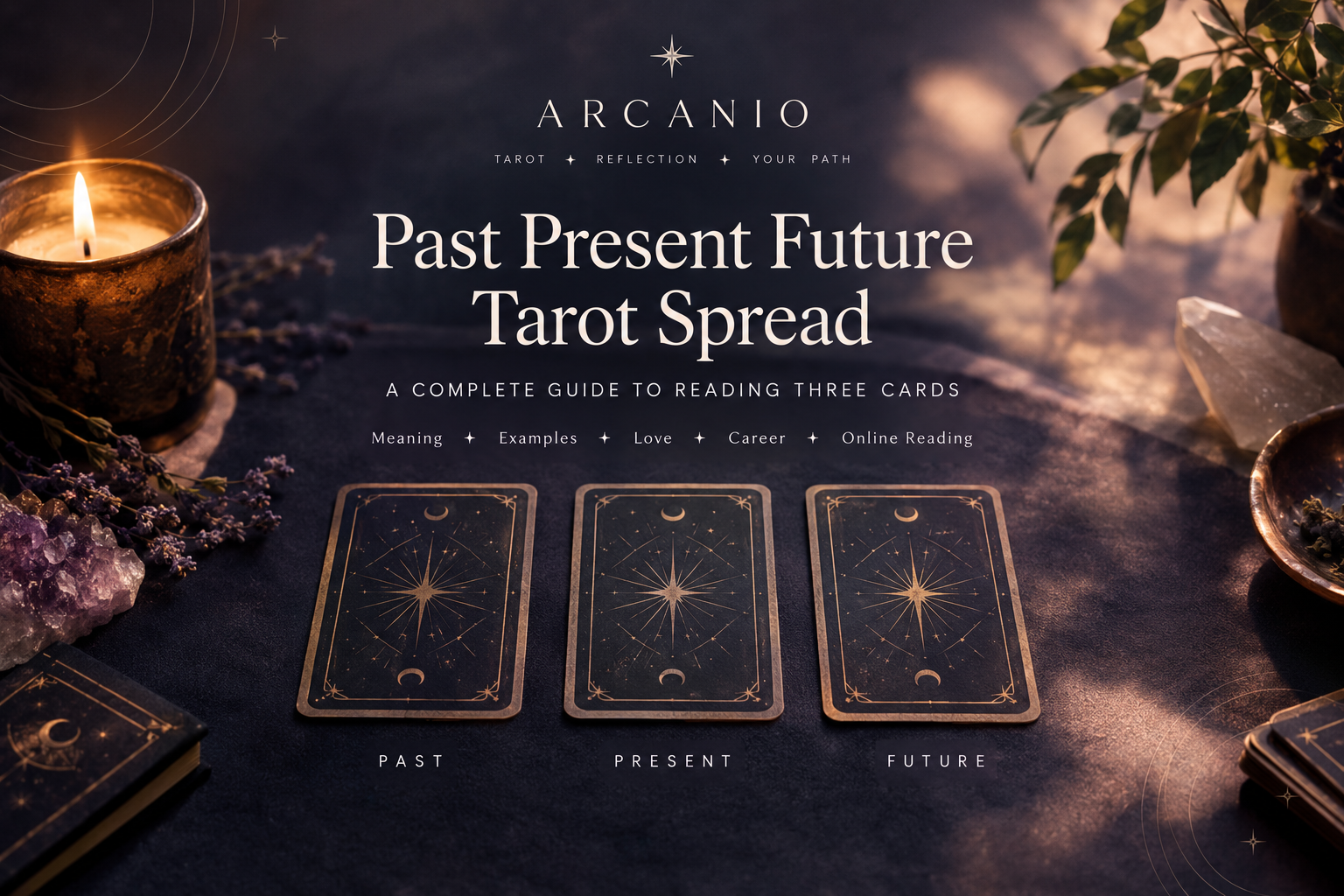
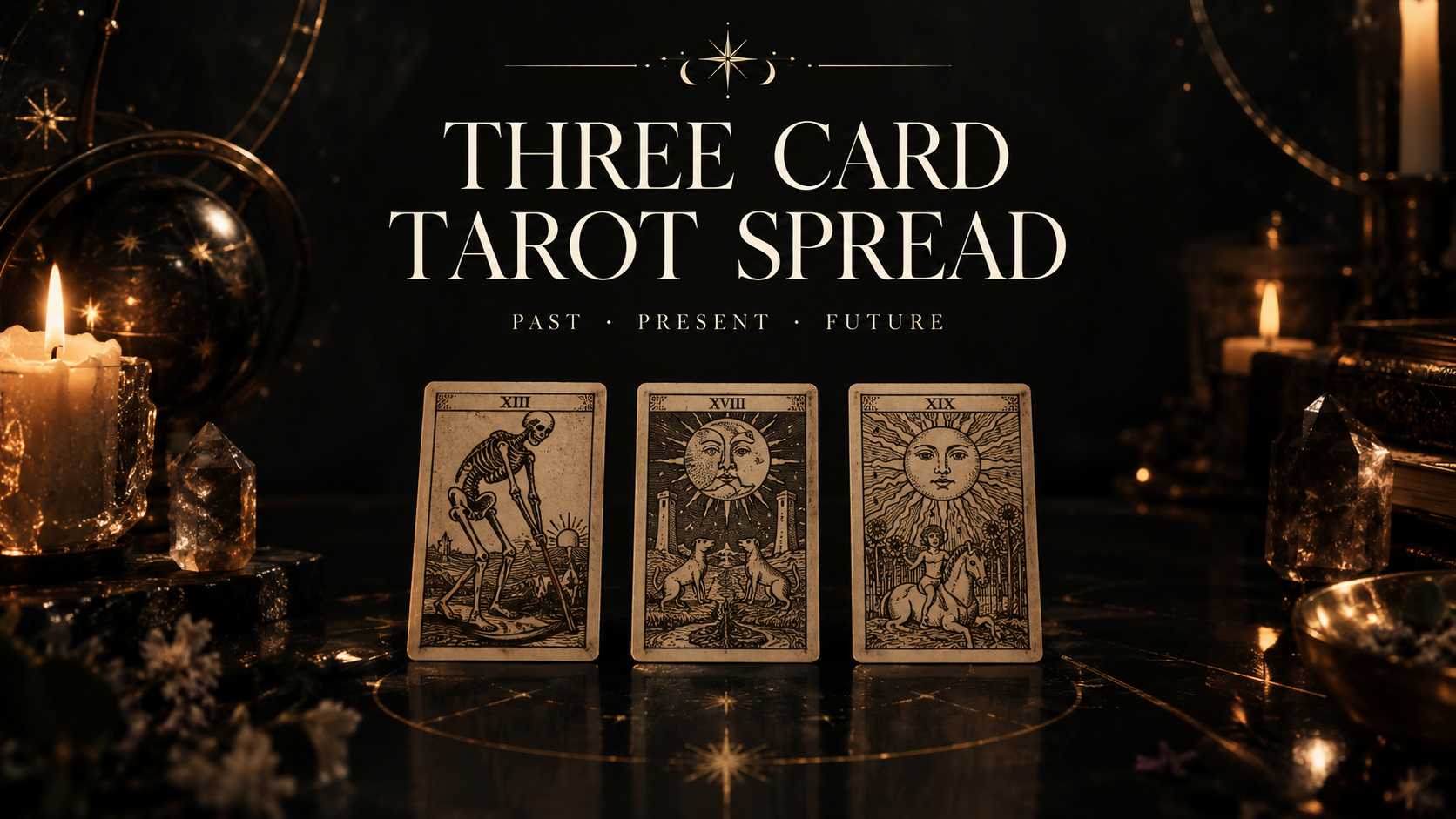
For example, a Past Present Future Tarot Spread can show how a situation developed, where it stands now, and what direction it may be moving toward.
A one-card reading is more focused.
You can think of the difference like this:
One card: One theme to explore.
Three cards: A story with multiple perspectives.
If you are asking a very simple question, one card may be enough.
If you want to understand a situation from several angles, a three-card spread may be more useful.
You can also combine both methods.
Start with one card.
If you genuinely need additional context, use a larger spread afterward rather than immediately pulling many cards.
When One Card Is Better Than a Large Tarot Spread
More cards do not automatically mean more clarity.
A large spread can be valuable when you have a complex question.
However, there are situations where one card is ideal.
Use a one card tarot reading when:
You are new to tarot.
You want a quick reading.
You have one focused question.
You want a daily reflection.
You are learning card meanings.
You want to journal.
You need a simple perspective.
You do not want to overthink a situation.
The simplicity can actually be an advantage.
One card forces you to spend more time with the card you have rather than constantly searching for another explanation.
Common One Card Tarot Mistakes
Asking too many questions
One card cannot realistically provide a detailed answer to five unrelated subjects.
Keep the question focused.
Immediately drawing another card
If you do not like your first card, it can be tempting to draw another.
Before doing that, ask yourself why you are dissatisfied with the first interpretation.
Sometimes the uncomfortable card is the one that deserves more attention.
Treating the card as a guaranteed prediction
Tarot can be used for reflection, symbolism, and personal exploration.
The future is influenced by circumstances and choices, so avoid treating a single card as an unavoidable outcome.
Ignoring your original question
The question gives the card context.
Always return to it when interpreting the card.
Looking only at keywords
A card's meaning is more than a few keywords.
Look at the artwork, position, question, surrounding context, and your own interpretation.
The History Behind Tarot Cards
Tarot has a long history that extends well beyond modern online tarot readings.
The Metropolitan Museum of Art explains that the earliest references to tarot date to the 1440s and 1450s in northern Italian cities including Venice, Milan, Florence, and Urbino. Early tarot decks combined standard Italian suits with additional trump cards. The museum also notes that tarot's modern association with fortune-telling and occult practice became prominent much later, particularly in the nineteenth century.
The British Museum similarly holds historical tarot-related objects and identifies tarot cards within its collections of playing cards and divination-related material.
This history is worth remembering because tarot has changed significantly across centuries.
Modern readers use the cards in many different ways, including symbolic reflection, creative exploration, spiritual practice, and entertainment.
You can learn more about the historical development of tarot through the Metropolitan Museum of Art and British Museum resources.
One Card Tarot Online
Today, you do not need a physical tarot deck to explore a one-card reading.
Online tarot platforms provide a convenient way to interact with cards digitally.
This can be useful if you are traveling, learning tarot, or simply want a quick reading from your phone or computer.
For a more immersive tarot experience, you can visit Arcanio.
Arcanio combines tarot symbolism with a modern visual experience, allowing visitors to explore their personal Arcana and tarot readings.
If you are beginning your tarot journey, an online experience can be an accessible way to become familiar with tarot imagery and card meanings.
How to Make Your One Card Tarot Practice More Meaningful
You do not need a complicated ritual to make a one-card reading meaningful.
Consistency can be more useful.
Try drawing one card at approximately the same time each day.
Write down your card.
Record your first reaction.
Then return to your notes later.
You might discover that a card you initially misunderstood becomes more meaningful as you gain experience.
You can also ask the same type of question every morning:
"What should I pay attention to today?"
After several weeks, your journal becomes a record of your relationship with the tarot.
You may notice recurring themes and learn which symbols naturally attract your attention.
Try One Card Tarot With Arcanio
If you want to explore tarot in a simple way, Arcanio provides a modern online environment for tarot exploration.
You can explore Arcanio and discover your personal Arcana and tarot experience.
A one-card practice can be a good place to start because it does not require you to understand complicated spreads.
Choose one question.
Take a moment.
Draw one card.
Look closely.
Then ask yourself what the card might help you notice.
The answer does not have to be dramatic.
Sometimes a small shift in perspective can be enough.
Frequently Asked Questions About One Card Tarot
What is One Card Tarot?
One Card Tarot is a simple tarot reading method that uses one card to explore a question, theme, lesson, or situation.
Is One Card Tarot good for beginners?
Yes. Because there is only one card to interpret, beginners can focus on learning tarot imagery and symbolism without becoming overwhelmed by a large spread.
What question should I ask for a one-card reading?
Good questions include "What should I focus on today?", "What should I understand about my current situation?", and "What lesson should I pay attention to?"
Can I do One Card Tarot every day?
Yes. A daily one-card reading can become a simple reflection or journaling practice.
Can One Card Tarot predict the future?
A single tarot card can be interpreted as a possible theme or direction, but it is better not to treat it as a guaranteed prediction of future events.
Should I use reversed cards?
You can. Reversed cards can add another layer of interpretation, but beginners may prefer to start with upright cards.
Is One Card Tarot better than a three-card spread?
They serve different purposes. One card provides a focused theme, while three cards provide more context and can create a timeline or narrative.
Can I do One Card Tarot online?
Yes. Digital tarot experiences allow you to explore tarot without a physical deck. You can also try Arcanio for an online tarot experience.
Final Thoughts on One Card Tarot
One Card Tarot proves that a tarot reading does not need to be complicated to be meaningful.
One card can give you a theme to think about, a symbol to explore, or a question you had not considered before.
The simplicity is part of the experience.
You do not need ten cards.
You do not need a complicated spread.
You need one question, one card, and enough time to consider what the card might mean in context.
Whether you use One Card Tarot as a morning ritual, a journaling exercise, a way to learn tarot, or simply a moment of reflection, the practice can become a valuable part of your tarot journey.
Start with a simple question.
Draw one card.
Look carefully at its imagery.
Consider its traditional meaning.
Then connect it to your own question and circumstances.
And if you want to explore tarot online, visit Arcanio and discover a modern tarot experience designed around personal Arcana and reflection.
Sometimes, one card is all you need to begin a new perspective.
The conversation
Be the first to say something
Comments are open to anyone with an account — it keeps the thread honest and your comments yours. It takes a moment and the weekly reading comes with it.