
The Strength tarot card meaning is connected to courage, patience, emotional resilience, self-control, compassion, and the ability to face challenges without relying on aggression. When Strength appears in a tarot reading, it encourages you to recognize the power of calm determination. This card is not simply about physical strength or overcoming other people. It represents the confidence to manage difficult emotions, respond thoughtfully under pressure, and remain committed to your values when circumstances become challenging.
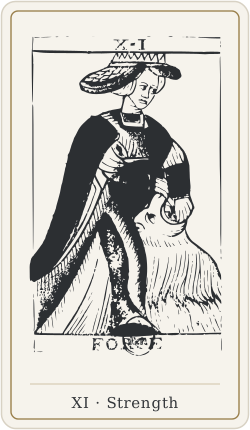
In the Marseille tarot tradition, Strength is numbered XI and occupies an important position among the Major Arcana. In the historic Jean Noblet-inspired deck used by Arcanio, the card belongs to a visual language of expressive figures, symbolic animals, and bold woodcut-style illustrations. Traditionally known as La Force, Strength depicts a woman holding the jaws of a lion. Her composed appearance contrasts with the animal's natural power, creating an image of courage guided by awareness rather than violence.
Strength can appear when you are navigating relationship difficulties, facing professional pressure, rebuilding confidence, or learning to manage strong emotions. It may encourage you to remain patient during a demanding situation, establish healthier boundaries, or recognize abilities you have underestimated. Its message is particularly valuable when fear, anger, uncertainty, or frustration makes it tempting to react impulsively.
In this guide, you will discover the Strength tarot card meaning in upright and reversed positions, including love, relationships, career, money, personal growth, spirituality, yes-or-no questions, and three-card readings. You will also learn how to interpret its traditional Marseille symbolism, understand important Strength tarot combinations, and explore practical ways to apply its message.
Strength Tarot Card Meaning at a Glance
Strength represents inner courage, emotional maturity, compassion, perseverance, and the ability to approach difficult circumstances with confidence and patience. It encourages you to recognize your abilities without allowing fear, anger, or the desire for control to determine your actions.
Upright Strength: Courage, patience, self-confidence, emotional resilience, compassion, determination, self-discipline, and inner power.
Reversed Strength: Self-doubt, insecurity, frustration, emotional overwhelm, impatience, excessive control, and difficulty trusting your abilities.
Love: Emotional maturity, patience, compassion, mutual support, healthy boundaries, and confidence within relationships.
Career: Professional resilience, leadership, confidence, persistence, conflict management, and the ability to handle pressure constructively.
Money: Financial discipline, thoughtful spending, patience, realistic planning, and resisting impulsive decisions.
Yes or no: Usually yes when the situation benefits from patience, courage, and consistent effort. Reversed Strength may indicate uncertainty or a need to rebuild confidence.
Elemental association: Fire in many modern tarot correspondence systems, although traditional Marseille interpretations do not universally depend on elemental assignments.
Astrological association: Leo in many modern esoteric tarot traditions.
Marseille number: XI.
Major Arcana: The eleventh numbered card.
The central question of Strength is simple: Can you approach a difficult situation with courage and compassion without allowing fear or frustration to control your response?
What Does the Strength Tarot Card Mean?
The Strength tarot card meaning centers on the relationship between power and self-control. It suggests that courage is not always expressed through confrontation, dramatic action, or the ability to dominate a situation. Sometimes, the greatest strength comes from responding calmly when circumstances are difficult.
The traditional image of a woman handling a lion illustrates this idea. The lion represents powerful instincts, emotions, and natural energy. The woman represents the ability to engage with that energy thoughtfully. Rather than destroying the animal or avoiding it, she interacts with it directly.
This symbolism can be applied to everyday experiences. You may feel angry during a disagreement, afraid before an important decision, or uncertain about your ability to manage a new responsibility. Strength encourages you to acknowledge those emotions without automatically allowing them to determine your behavior.
The card also represents perseverance. Some goals require repeated effort, gradual learning, and the willingness to continue after disappointment. Strength reminds you that progress does not always happen quickly and that patience can be an important part of developing confidence.
However, perseverance should not be confused with enduring every situation indefinitely. Continuing to tolerate harmful behavior, unreasonable demands, or unsafe circumstances is not proof of strength. Sometimes courage involves setting a boundary, seeking help, or deciding to leave.
Another important aspect of Strength is compassion. You may be capable of handling a challenge while still treating yourself and others with kindness. Confidence does not require dismissing another person's feelings, and self-discipline does not require punishing yourself for every mistake.
In relationships, Strength can emphasize emotional maturity and mutual support. At work, it can represent patient leadership and the ability to respond constructively under pressure. In personal development, it encourages you to recognize that real confidence often develops through experience.
The deeper lesson is that strength becomes most valuable when it is guided by awareness, responsibility, and respect rather than the desire to control everything around you.
Upright Strength Tarot Card Meaning
When Strength appears upright, it generally represents courage, confidence, patience, emotional resilience, and the capacity to manage challenges without becoming overwhelmed by them.
You may be experiencing a situation that requires steady determination. Perhaps you are working toward an important goal, addressing a difficult conversation, or trying to change a habit that has become deeply established.
Upright Strength encourages you to trust your ability to respond thoughtfully, even when the outcome remains uncertain.
This card can be especially constructive during periods when progress feels slow. Building a skill, repairing trust, establishing healthier habits, and developing professional expertise often require repeated effort. Strength reminds you that consistent action may be more effective than dramatic gestures.
The card can also represent emotional regulation. You may be learning to recognize anger before reacting, acknowledge fear without becoming immobilized, or handle criticism without allowing it to determine your sense of worth.
Importantly, emotional regulation is not the same as suppressing feelings. Ignoring anger, sadness, or anxiety does not make those emotions disappear. Strength encourages you to understand what you are feeling and choose a response that reflects your values.
Upright Strength may also indicate growing confidence. You could be recognizing that previous experiences have prepared you for responsibilities you once considered intimidating.
However, this confidence does not mean that you will never need assistance. Seeking advice, delegating responsibilities, or acknowledging your limitations can be expressions of sound judgment.
Strength also highlights the relationship between firmness and compassion. You can communicate a boundary clearly without being cruel. You can disagree without humiliating another person. You can pursue a goal without treating every obstacle as an enemy.
The card ultimately encourages courage that is sustainable rather than exhausting.
Its message is to remain determined while recognizing when patience, flexibility, and support are more useful than force.
Upright Strength Keywords
Courage, confidence, patience, compassion, perseverance, emotional resilience, self-control, inner power, determination, discipline, maturity, kindness, and calm leadership.
Reversed Strength Tarot Card Meaning
The reversed Strength tarot card meaning often involves self-doubt, insecurity, impatience, emotional overwhelm, or difficulty expressing personal power in a balanced way.
Where upright Strength emphasizes confidence and thoughtful control, the reversed position invites you to examine whether fear, frustration, or a lack of trust in yourself is influencing your decisions.
You may be facing a challenge that feels larger than your current abilities. Perhaps you are questioning whether you deserve an opportunity, comparing yourself unfavorably with others, or avoiding a responsibility because you are afraid of failing.
Reversed Strength can encourage you to distinguish between genuine limitations and assumptions about what you cannot accomplish.
A lack of confidence does not necessarily mean a lack of ability. You may possess useful skills but struggle to recognize them because of previous disappointments or unrealistic expectations.
The reversed card can also represent the opposite problem: attempting to control circumstances too aggressively.
When you feel uncertain, it may be tempting to pressure another person, demand immediate results, or treat disagreement as a threat to your authority.
Strength reversed asks whether greater control would actually improve the situation or whether a more patient approach would be constructive.
In some readings, this card can highlight emotional exhaustion. You might have been trying to manage too many responsibilities without allowing yourself sufficient rest or support.
If this interpretation resonates, the solution may not involve pushing yourself harder. Instead, you may need to reconsider your workload, establish boundaries, or seek assistance.
In relationships, reversed Strength can reflect insecurity, recurring frustration, or difficulty handling emotional disagreements. At work, it may suggest reduced confidence, impatience, or challenges with leadership.
However, reversed Strength does not establish that someone is aggressive, untrustworthy, or incapable of change. Tarot cards cannot provide reliable evidence about another person's private intentions.
The constructive message is to recognize where your confidence needs rebuilding and where a different approach may help you regain balance.
Reversed Strength Keywords
Self-doubt, insecurity, impatience, frustration, emotional overwhelm, excessive control, fear, uncertainty, low confidence, exhaustion, and difficulty maintaining boundaries.
Strength Tarot Card Meaning in Love and Relationships
The Strength tarot card meaning in love focuses on emotional maturity, patience, compassion, mutual respect, and the ability to maintain a healthy relationship during challenging experiences.
Strength encourages you to understand that meaningful relationships require more than attraction. They also depend on communication, emotional responsibility, respect for boundaries, and the willingness to approach disagreements constructively.
The card can be reassuring, but it does not guarantee that a relationship will succeed.
Upright Strength in Love
If you are in a relationship, upright Strength encourages patience, understanding, and thoughtful communication.
Every partnership encounters situations in which two people have different needs or expectations. These differences do not automatically indicate incompatibility, but the way they are handled can influence the quality of the relationship.
Strength encourages you to approach disagreements without treating them as competitions.
Instead of focusing only on proving that you are right, consider whether you understand your partner's perspective and whether your concerns have been communicated clearly.
The card can also represent the ability to support one another during stressful circumstances.
A relationship may be affected by professional challenges, family responsibilities, financial uncertainty, or periods of personal change. Strength reminds you that mutual support can help both partners respond more thoughtfully.
However, compassion should not require you to ignore your own needs. Healthy patience includes recognizing when a conversation needs to happen or when a boundary must be respected.
For couples considering a long-term commitment, Strength may encourage an honest discussion about how both people handle pressure, responsibility, and emotional conflict.
It does not automatically promise marriage or permanent stability.
Instead, it highlights the qualities that help relationships develop a stronger foundation.
If you are single, upright Strength may represent growing self-confidence and emotional independence.
You may be learning to approach dating without allowing previous disappointments to determine your expectations.
The card encourages you to value mutual respect and consistency rather than pursuing relationships primarily for reassurance.
Being confident in love does not mean never feeling vulnerable. It means being willing to communicate honestly while respecting your own boundaries.
Reversed Strength in Love
Reversed Strength may suggest that insecurity, impatience, or unresolved emotional tension is influencing a relationship.
You may feel that small disagreements become difficult to manage or that one partner struggles to express concerns without becoming defensive.
The card encourages you to examine the underlying emotions rather than focusing only on the immediate argument.
For example, repeated disagreements about communication may reflect different expectations, insecurity, or a lack of clarity about boundaries.
Reversed Strength may also highlight jealousy or attempts to control another person's behavior. When insecurity becomes the basis for restrictions, accusations, or pressure, the relationship may need a more honest examination of trust and respect.
The card should not be used to excuse controlling or abusive behavior.
If a relationship involves threats, intimidation, coercion, or harm, patience alone is not a solution. Protecting your safety and seeking appropriate support take priority.
For singles, reversed Strength can encourage reflection on self-worth. You may be overlooking your own needs because you want a relationship to succeed or avoiding new connections because you fear rejection.
The message is not to force yourself to become more outgoing.
Instead, consider how greater self-respect and emotional awareness could support healthier choices.
Strength Tarot Card as Feelings
When asking how someone feels about you, Strength can symbolically represent affection, admiration, patience, attraction, or emotions that require careful handling.
Upright Strength may suggest a theme of respect, emotional restraint, or the desire to approach a connection thoughtfully.
Reversed Strength may highlight insecurity, uncertainty, vulnerability, or difficulty expressing emotions.
However, tarot cards cannot reliably reveal another person's private feelings.
If you want to understand someone's intentions, their communication, behavior, and willingness to build a relationship provide more dependable information.
Strength encourages emotional honesty rather than relying entirely on assumptions.
Strength Tarot Card Meaning in Career and Work
The Strength tarot card meaning in career readings emphasizes confidence, resilience, patient leadership, perseverance, and the ability to handle professional challenges constructively.
Work often requires balancing ambition with cooperation. You may need to defend an idea, negotiate responsibilities, manage a difficult project, or remain focused despite uncertainty.
Strength encourages you to approach these situations with preparation and emotional maturity.
Upright Strength in Career
Upright Strength can be a constructive card when you are pursuing a challenging professional goal.
You may be preparing for an interview, learning a demanding skill, taking on leadership responsibilities, or managing a project that requires sustained effort.
The card encourages you to recognize your abilities while remaining realistic about the work involved.
Confidence can become especially valuable when you need to communicate your experience or advocate for yourself.
If you are requesting a promotion or negotiating responsibilities, Strength favors a calm explanation of your contributions rather than aggression or unnecessary confrontation.
The card also emphasizes resilience.
Professional development rarely follows a perfectly predictable path. You may encounter criticism, delays, or projects that require several attempts before producing a satisfactory result.
Strength encourages you to learn from feedback without treating every setback as proof of failure.
For managers, the card can represent leadership through consistency, fairness, and emotional awareness.
A strong leader does not need to intimidate employees to establish authority. Clear expectations, respectful communication, and accountability can create a more constructive environment.
For independent professionals and business owners, Strength may symbolize persistence through uncertainty.
Developing a business, building trust with customers, or improving a service often requires patience and a willingness to adapt.
However, perseverance should be combined with sound evaluation.
If an approach repeatedly produces poor results, changing direction may demonstrate better judgment than continuing without reconsideration.
The central lesson is that professional strength comes from combining confidence with responsibility.
Reversed Strength in Career
Reversed Strength may suggest reduced confidence, professional frustration, emotional exhaustion, or difficulty managing pressure.
Perhaps you are questioning your qualifications, avoiding an important conversation, or feeling overwhelmed by competing responsibilities.
The card encourages you to examine the specific source of that difficulty.
If you lack experience in a particular area, additional training or guidance may help.
If you possess the necessary skills but doubt yourself, reviewing your achievements and requesting constructive feedback may provide a more accurate perspective.
Reversed Strength can also highlight workplace conflict.
You may feel pressured to react aggressively to criticism or become frustrated when colleagues do not follow your preferred approach.
The card encourages you to focus on clear communication and practical solutions.
For managers, reversed Strength may raise questions about leadership style.
Are you delegating appropriately? Are expectations realistic? Are disagreements being addressed respectfully?
If you are experiencing exhaustion, consider whether your responsibilities can be adjusted rather than assuming that you must tolerate unlimited pressure.
Strength does not encourage remaining in an unsafe or exploitative workplace simply to demonstrate resilience.
Its message is to protect your well-being while finding effective ways to pursue your professional goals.
Strength Tarot Card Meaning for Money and Finances
In financial readings, Strength represents discipline, patience, thoughtful decision-making, and the ability to manage financial pressure without relying on impulsive choices.
The card is not primarily associated with sudden wealth or unexpected rewards.
Instead, it encourages a consistent and informed approach to money.
Upright Strength in Money Readings
Upright Strength can encourage you to examine how your financial habits reflect your priorities.
You may be working toward a savings goal, reducing unnecessary expenses, or preparing for a significant financial responsibility.
The card emphasizes patience because meaningful financial progress often requires repeated decisions rather than one dramatic action.
If you are trying to improve your budget, Strength encourages realistic planning.
Rather than expecting yourself to change every habit immediately, consider which adjustments would be sustainable.
The card can also relate to financial confidence.
Perhaps you are learning to ask questions about contracts, compare alternatives, or discuss financial responsibilities more openly.
Being informed can help you make decisions without depending entirely on another person's recommendations.
Strength may also encourage you to resist emotional spending.
When you feel frustrated, anxious, or disappointed, an immediate purchase may seem appealing. The card invites you to recognize those feelings before making a financial commitment.
However, self-discipline does not mean denying yourself every enjoyable experience. The goal is a balanced approach that reflects your circumstances.
If you are considering investments, borrowing, or major purchases, use reliable information and qualified advice when necessary.
The card does not guarantee financial success.
Reversed Strength in Money Readings
Reversed Strength may suggest difficulty maintaining financial habits, anxiety about money, or decisions influenced by short-term emotions.
You might be avoiding your budget because reviewing it feels uncomfortable or making commitments without fully understanding their consequences.
The card encourages you to approach the situation without unnecessary self-criticism.
Financial challenges do not always result from poor discipline. Income changes, unexpected expenses, and difficult economic conditions can influence your options.
Start by identifying what is actually happening.
Reviewing recurring expenses, clarifying obligations, or seeking professional guidance may help you make more informed choices.
Reversed Strength may also encourage you to reconsider unrealistic expectations.
A financial plan that requires constant deprivation or leaves no room for ordinary needs may be difficult to maintain.
The practical lesson is to combine responsibility with realistic planning.
Strength Tarot Card Meaning for Personal Growth
Strength is closely connected to personal development because it encourages you to understand the relationship between emotions, confidence, and behavior.
Many people associate strength with never feeling afraid, uncertain, or disappointed. The card challenges that assumption.
Courage can involve acknowledging fear while still choosing a responsible action.
For example, you may feel nervous before speaking in public but decide to prepare and participate. You may find a difficult conversation uncomfortable yet recognize that avoiding it would create more problems.
Strength encourages you to view these experiences as opportunities to develop confidence gradually.
The card also highlights emotional awareness.
Anger, sadness, fear, and frustration are normal human experiences. Problems can arise when these feelings automatically determine how you treat yourself or other people.
Learning to recognize an emotional response before acting can provide more choices.
However, Strength does not require you to remain calm every moment. Emotional growth includes accepting that you will sometimes react imperfectly.
What matters is whether you can recognize your behavior, take responsibility when necessary, and develop a more constructive response.
Another important theme is self-compassion.
You may be demanding more from yourself than you would reasonably expect from someone else.
Strength encourages you to distinguish between accountability and unnecessary self-punishment.
You can work toward improvement without assuming that every mistake reflects a personal failure.
Reversed Strength may suggest that negative self-talk or unrealistic comparisons are reducing your confidence.
If you constantly focus on what you have not achieved, consider reviewing the experience and knowledge you have already developed.
Personal growth is not always visible through dramatic achievements.
Sometimes it appears in the ability to have a difficult conversation, maintain a boundary, ask for assistance, or respond differently to a familiar challenge.
The deeper message is that emotional resilience develops through consistent practice, not through pretending to be unaffected by life.
Strength Tarot Card Meaning in Spirituality
Spiritually, the Strength tarot card meaning centers on inner balance, conscious awareness, compassion, and the relationship between instinct and thoughtful action.
In the Marseille tradition, the image of a woman holding a lion offers a powerful starting point for reflection.
The animal can symbolize strong emotions, desires, fears, and instinctive reactions. The woman represents the possibility of engaging with these experiences through awareness.
This does not mean that instinct is inherently negative.
Emotions and desires can provide useful information about needs, values, and boundaries.
Strength encourages you to understand these signals without allowing them to become the sole basis for every decision.
The card can also support spiritual practices involving patience and self-observation.
Meditation, journaling, reflective reading, and other contemplative activities may help you recognize recurring reactions and explore their meaning.
However, spiritual development does not require suppressing difficult emotions or avoiding practical responsibilities.
A balanced interpretation encourages you to connect inner awareness with everyday behavior.
If you value compassion, consider how you express it during disagreements. If you value patience, examine how you respond when progress is slow.
Strength can also encourage humility.
Feeling spiritually confident does not mean that your interpretation of every experience is correct. Remaining open to uncertainty and other perspectives can be part of a thoughtful spiritual practice.
Reversed Strength may suggest that fear, frustration, or unrealistic expectations are interfering with your sense of balance.
You may be judging yourself for having ordinary emotional reactions or expecting spiritual practices to eliminate every difficulty.
The card reminds you that personal development is gradual.
For another perspective on inner awareness, explore Arcanio's guide to The High Priestess tarot card meaning. Both cards encourage self-understanding, but Strength particularly emphasizes how that understanding influences your actions.
Is Strength a Yes-or-No Tarot Card?
Strength is generally considered a positive card in yes-or-no tarot readings, especially when a question involves courage, patience, perseverance, or the ability to work through a challenge.
However, its answer is conditional rather than an unconditional promise.
Upright Strength: Usually yes, particularly when you are prepared to act with patience, confidence, and consistent effort.
The card encourages you to recognize your abilities and approach difficulties thoughtfully.
Reversed Strength: Uncertain, delayed, or leaning no when insecurity, excessive pressure, or emotional overwhelm is influencing the situation.
It may suggest that you need greater preparation, clearer boundaries, or additional support before proceeding.
For relationship questions, Strength does not guarantee that someone will remain committed or that a disagreement will automatically be resolved.
Instead, it encourages consideration of whether both people are communicating respectfully and accepting responsibility for their behavior.
For career questions, Strength can support the idea of pursuing a challenging opportunity, provided you evaluate your preparation and circumstances realistically.
For financial questions, it encourages disciplined decisions rather than treating the card as evidence that a particular investment will succeed.
A useful follow-up question is: What would help me approach this situation with greater confidence and patience?
This turns a yes-or-no reading into an opportunity for reflection.
Strength in a Past, Present, and Future Tarot Spread
In a three-card tarot spread, Strength can represent different aspects of courage, confidence, and emotional development depending on its position.
The card should be interpreted alongside the other cards and the original question.
Strength in the Past Position
When Strength appears in the past position, it may represent an earlier experience that required perseverance, patience, or emotional resilience.
Perhaps you navigated a difficult transition, learned to manage an important responsibility, or developed confidence through repeated practice.
The card encourages you to consider what that experience taught you.
You may have discovered that you were more capable than you initially believed.
Alternatively, the past position may highlight a situation in which you relied too heavily on endurance and neglected your own needs.
Ask yourself whether the lessons from that experience continue to support your present decisions.
Strength in the Present Position
In the present position, Strength brings attention to the courage and emotional awareness required by your current circumstances.
You may need to communicate a difficult truth, pursue a challenging goal, or manage frustration without allowing it to determine your behavior.
The card encourages you to recognize your abilities while remaining open to guidance.
It may also highlight the value of patience.
If you are dealing with a situation that cannot be resolved immediately, focus on the actions you can take responsibly rather than demanding instant certainty.
The present position reminds you that strength is expressed through decisions made now.
Strength in the Future Position
When Strength appears in the future position, it may symbolize a situation in which courage, perseverance, or emotional maturity could become important.
You might be preparing for a new responsibility, developing a skill, or approaching a decision that requires confidence.
This is not a guarantee that hardship will occur or that every challenge will be overcome.
Instead, the card encourages you to strengthen the resources that could help you respond thoughtfully.
Consider whether preparation, support, or clearer priorities would make a future decision easier.
To explore this reading method further, visit Arcanio's Past, Present, and Future Tarot Spread guide.
You can also use the Arcanio tarot reading experience to explore a personal question through a three-card spread.
Strength Tarot Card Combinations
The Strength tarot card meaning can change when it appears beside another Major Arcana card.
Strength often introduces themes of courage, patience, emotional regulation, and compassion, while the surrounding card helps explain where those qualities may be needed.
The following combinations are useful starting points rather than fixed predictions.
Strength and The Fool
Strength and The Fool bring together courage and new beginnings.
The Fool represents openness, curiosity, and the willingness to explore unfamiliar possibilities. Strength emphasizes patience, emotional resilience, and confidence.
Together, these cards may suggest that you are considering a new experience that requires both enthusiasm and preparation.
You may be ready to begin something meaningful but feel uncertain about your ability to handle unexpected challenges.
This combination encourages you to remain curious without allowing impulsiveness to replace judgment.
Strength and The Magician
Strength and The Magician connect personal ability with emotional discipline.
The Magician represents skills, resources, initiative, and the capacity to turn ideas into action. Strength emphasizes using those abilities with patience and responsibility.
In career readings, this pairing may encourage you to pursue a project with confidence while managing setbacks constructively.
In personal development, it can highlight the importance of combining initiative with emotional maturity.
The central lesson is that ability becomes more effective when guided by self-awareness.
Strength and The High Priestess
Strength and The High Priestess emphasize the relationship between inner awareness and thoughtful action.
The High Priestess encourages attention to intuition, reflection, and information that may not yet be fully understood.
Strength adds courage and the ability to respond constructively to what you discover.
Together, these cards may suggest that you need to understand your emotions before making an important decision.
However, intuition should not be treated as proof of another person's intentions.
The combination encourages reflection supported by practical judgment.
Strength and The Empress
Strength and The Empress bring together compassion, resilience, creativity, and nurturing.
The Empress represents growth, care, and the conditions that help something develop. Strength emphasizes the patience required to support that development.
In relationships, this combination can encourage kindness balanced with clear boundaries.
For creative projects, it may suggest that promising ideas need consistent effort and a supportive environment.
Together, the cards remind you that meaningful growth involves both care and determination.
Strength and The Emperor
Strength and The Emperor highlight the relationship between personal power, leadership, and emotional control.
The Emperor represents structure, authority, responsibility, and established boundaries.
Strength emphasizes confidence expressed through patience rather than intimidation.
Together, these cards may encourage you to approach leadership with a balance of firmness and compassion.
In professional readings, the pairing can suggest the importance of clear expectations and respectful accountability.
It also invites you to consider whether control is being used constructively or excessively.
Strength and The Pope
Strength and The Pope connect inner courage with established values, guidance, and ethical responsibility.
The Pope emphasizes teaching, tradition, community, and the principles that influence behavior.
Strength asks whether those principles are being practiced with patience and compassion.
This combination may be relevant when you are trying to act according to your beliefs during a difficult situation.
It encourages you to learn from experienced people while developing your own judgment.
A strong commitment to values should support thoughtful behavior rather than rigid intolerance.
Strength and The Lovers
Strength and The Lovers bring together emotional maturity, relationships, attraction, and meaningful decisions.
The Lovers emphasizes connection, compatibility, and choices guided by personal values.
Strength encourages patience, honesty, and confidence within those choices.
In love readings, this combination may highlight the importance of mutual respect and emotional responsibility.
It can encourage you to communicate your needs without trying to control another person's response.
The pairing suggests that healthy connection benefits from both vulnerability and self-respect.
Strength and The Chariot
Strength and The Chariot combine determination with emotional discipline.
The Chariot emphasizes direction, momentum, and the effort required to pursue a goal.
Strength focuses on managing the emotional pressures that may arise during that pursuit.
Together, these cards can suggest an opportunity to make progress through preparation and consistent effort.
However, determination should not become reckless ambition.
The combination encourages you to remain focused while recognizing when flexibility or rest is necessary.
Strength and Justice
Strength and Justice emphasize courage, fairness, accountability, and careful judgment.
Justice encourages decisions based on honesty, evidence, and responsibility. Strength adds the patience to handle difficult truths without responding impulsively.
This combination may be relevant when you need to address a conflict or make a decision that affects other people.
It encourages you to stand by your principles while respecting the perspectives and needs involved.
The central lesson is that fairness often requires both clarity and compassion.
Strength and The Hermit
Strength and The Hermit bring together emotional resilience and self-reflection.
The Hermit emphasizes introspection, patience, and wisdom developed through experience.
Strength encourages you to apply that understanding when facing difficulties.
This pairing may suggest that you need time to examine your feelings before taking action.
It can also encourage you to distinguish productive solitude from avoiding an uncomfortable responsibility.
Together, the cards support thoughtful confidence.
Strength and Wheel of Fortune
Strength and Wheel of Fortune connect emotional resilience with changing circumstances.
The Wheel of Fortune represents cycles, opportunities, and events that may not be entirely within your control.
Strength emphasizes your ability to respond thoughtfully as those conditions change.
This combination can be particularly meaningful during professional or personal transitions.
You may not determine the timing of every opportunity, but you can prepare, remain flexible, and manage uncertainty constructively.
The cards remind you that confidence does not require controlling every outcome.
Strength and The Hanged Man
Strength and The Hanged Man emphasize patience, restraint, and the willingness to approach a situation differently.
The Hanged Man represents pause, reconsideration, and a change in perspective.
Strength adds the courage to remain calm when immediate progress is unavailable.
Together, these cards may encourage you to stop forcing a result and examine whether another approach would be more effective.
Waiting can be constructive when it creates understanding, but it should not become indefinite avoidance.
Strength and The Star
Strength and The Star bring together courage, hope, and the rebuilding of confidence.
The Star represents inspiration, renewal, and the possibility of developing a more hopeful perspective.
Strength emphasizes the steady effort that may be required to act on that hope.
This combination can encourage you to recognize progress after a disappointing experience.
It does not guarantee that difficulties will disappear, but it supports optimism grounded in practical action.
Hope becomes more meaningful when combined with patience and self-respect.
Strength Tarot Card Symbolism in the Marseille Tradition
The traditional Marseille image of Strength is memorable because it presents an encounter between a human figure and a powerful animal.
A woman stands beside a lion, placing her hands near or on its jaws. Unlike images of combat, she does not carry a weapon or appear to be engaged in a violent struggle.
The visual contrast creates an important question: What does it mean to possess strength without relying entirely on force?
In the Jean Noblet-inspired deck used by Arcanio, this scene connects Strength with the wider symbolism of early Marseille tarot.
The Number XI
In the Marseille sequence, Strength is numbered XI.
This differs from the Rider–Waite–Smith tradition, where Strength is numbered VIII and Justice occupies XI.
The distinction matters when comparing tarot decks and interpretations.
Arcanio follows the Marseille arrangement:
Justice is VIII, The Hermit is IX, Wheel of Fortune is X, and Strength is XI.
The number eleven helps establish Strength's position in the sequence, but its meaning should not be reduced to numerology alone.
Some modern numerological interpretations associate eleven with intuition, insight, or heightened awareness. These associations are interpretive rather than universal features of historical Marseille tarot.
The most important clues remain the card's traditional imagery and its role within a reading.
The Woman
The central human figure represents calm authority, confidence, and the possibility of directing powerful energy without unnecessary aggression.
Her appearance contrasts with the physical power associated with the lion.
This difference is important because the card does not simply show two equally forceful opponents.
Instead, it suggests that awareness and composure may accomplish something that physical confrontation cannot.
In a reading, the woman can encourage you to examine how you respond to pressure.
Do you feel a need to prove your strength through confrontation, or can you remain confident without escalating a disagreement?
The figure represents an approach to power based on control of one's own behavior.
The Lion
The lion is one of Strength's most recognizable symbols.
Lions have long been associated with courage, vitality, instinct, and physical power.
In the tarot image, the animal can represent emotional intensity, desire, anger, fear, or other forces that require thoughtful attention.
However, the lion should not automatically be interpreted as something evil or destructive.
Instinctive energy can also provide motivation, confidence, and the determination to protect important boundaries.
The card suggests that the goal is not to eliminate this energy but to understand how it can be expressed constructively.
In practical readings, the lion may encourage you to recognize the difference between feeling something strongly and acting without reflection.
The Hands and the Lion's Jaws
The interaction between the woman's hands and the lion's jaws is central to the Marseille image.
Depending on the historical illustration, the gesture can appear as though the woman is opening, holding, or controlling the animal's mouth.
This ambiguity creates several possible interpretations.
The mouth can symbolize the expression of powerful energy, while the hands suggest deliberate engagement with that energy.
The woman does not appear to be striking the lion or fleeing from it.
Instead, she meets its power directly.
Symbolically, this can represent the ability to handle difficult emotions without allowing them to become destructive.
It may also encourage reflection on communication.
Strong words can influence relationships, and emotional reactions can affect important decisions.
Strength reminds you that how you express power matters.
The Hat and Clothing
In Marseille imagery, the woman often wears an elaborate hat and colorful clothing.
The hat is sometimes compared with the broad, curved headwear of The Magician, another figure associated with skill and personal agency.
Some later interpretations connect the hat's shape with infinity symbolism.
However, the historical Marseille image should not be confused with the separate floating infinity sign found above the woman's head in Rider–Waite–Smith artwork.
The clothing contributes to the card's visual contrast between human composure and animal strength.
Its decorative character emphasizes that the figure does not rely on armor or weapons.
In a reflective interpretation, this can reinforce the idea that confidence does not require an aggressive appearance.
The Woman's Composed Expression
The woman's relatively composed expression is another important detail.
She appears focused on the interaction rather than overcome by fear or anger.
This creates a visual impression of emotional steadiness.
However, the image should not be interpreted as suggesting that courageous people never feel afraid.
Courage often involves responding thoughtfully despite fear.
The woman's posture and expression can encourage you to consider how greater awareness might change your response to a challenging situation.
Her strength lies not simply in facing the lion but in the manner in which she engages with it.
The Jean Noblet and Marseille Tradition
The Jean Noblet tarot is a historically significant example of the early Marseille pattern, associated with Paris around 1650.
Arcanio uses artwork inspired by this deck, connecting its digital tarot experience with a traditional visual language of expressive figures, symbolic objects, and recognizable card compositions.
Strength, historically called La Force, belongs to a much older European tradition of depicting courage and fortitude as virtues.
The card's imagery presents strength as more than physical dominance.
The interaction between the woman and lion can be understood as an illustration of power guided by judgment.
This context is useful when comparing Marseille tarot with later systems.
Modern decks sometimes introduce additional symbols, change numbering, or emphasize different aspects of the card.
Recognizing those differences helps keep the interpretation grounded in Arcanio's historical source.
To explore the complete collection, visit the Arcanio tarot deck and the guide to all 78 tarot card meanings.
What Should You Do When Strength Appears?
When Strength appears in a tarot reading, begin by identifying the challenge that requires your attention.
The card is most useful when its symbolism is connected to a specific question rather than treated as a promise that every obstacle will disappear.
First, recognize the emotions involved.
You may be feeling frustration, fear, excitement, disappointment, or uncertainty. Identifying those emotions can help you understand why a situation feels difficult.
Second, consider how you are responding.
Are you avoiding the issue, reacting impulsively, or trying to control something that is not entirely within your influence?
Strength encourages you to distinguish between emotional reactions and actions that support your goals.
Third, identify where patience may be useful.
Some challenges require gradual learning, repeated effort, or a willingness to listen before making a decision.
Fourth, consider whether compassion is missing from your approach.
You may need to treat yourself more reasonably, understand another person's perspective, or communicate a boundary without unnecessary hostility.
Finally, recognize when seeking support would be constructive.
Strength does not require you to handle every difficulty alone.
A trusted friend, experienced mentor, counselor, or qualified professional may help you understand a situation more clearly.
Ask yourself: What would courage look like here if I did not need to prove anything to anyone?
This question can help transform the card's symbolism into a practical opportunity for reflection.
For more guidance on tarot interpretation, explore the Arcanio journal, where you can discover card meanings, traditional symbolism, and practical reading methods.
Frequently Asked Questions About the Strength Tarot Card
Is Strength a good card in tarot?
Strength is generally considered constructive because it represents courage, patience, confidence, compassion, and emotional resilience. However, it can also bring attention to challenges that require difficult decisions. Its value lies in encouraging thoughtful responses rather than guaranteeing a favorable outcome.
What does Strength mean when it appears upright?
Upright Strength represents courage, perseverance, self-control, patience, and emotional maturity. It encourages you to recognize your abilities and approach challenging circumstances with confidence and compassion instead of impulsiveness.
What does reversed Strength mean?
Reversed Strength can suggest self-doubt, insecurity, impatience, frustration, emotional exhaustion, or attempts to control situations too aggressively. It may encourage you to rebuild confidence, reconsider your expectations, or seek appropriate support.
What does Strength mean in love?
In love readings, Strength emphasizes compassion, emotional maturity, patience, mutual respect, and healthy boundaries. For couples, it can encourage constructive communication during disagreements. For singles, it may highlight growing confidence and clearer relationship expectations.
Does Strength mean someone loves you?
Strength can symbolically represent affection, patience, or emotional commitment, but it cannot confirm that someone loves you. A person's feelings are better understood through their communication, consistent behavior, and willingness to participate in the relationship.
Does Strength mean reconciliation?
Strength may encourage patience, understanding, and the possibility of handling disagreements constructively. However, it does not guarantee reconciliation. Rebuilding a relationship depends on the choices, communication, boundaries, and willingness of the people involved.
What does Strength mean in a career reading?
In career readings, Strength represents professional confidence, resilience, leadership, perseverance, and emotional awareness. It may encourage you to prepare for challenges, communicate clearly, and maintain realistic expectations while pursuing your goals.
What does Strength mean for money?
Strength in financial readings emphasizes patience, budgeting, self-discipline, and thoughtful decisions. It encourages you to understand your financial circumstances and avoid impulsive commitments. The card does not predict guaranteed wealth or investment success.
Is Strength a yes-or-no tarot card?
Strength is usually interpreted as a conditional yes when upright, particularly in situations requiring courage, patience, and consistent effort. Reversed Strength may indicate uncertainty, insecurity, or the need for greater preparation before proceeding.
What does Strength mean as someone's feelings?
As a symbolic representation of feelings, Strength may suggest admiration, affection, emotional restraint, or a desire to handle a connection carefully. Reversed, it may highlight uncertainty or insecurity. Tarot cannot reliably reveal another person's private emotions.
What does Strength mean spiritually?
Spiritually, Strength represents the relationship between instinct, emotional awareness, compassion, and conscious action. It encourages reflection on how your values influence your behavior during difficult experiences.
Is Strength associated with Leo?
Strength is associated with Leo in many modern esoteric tarot systems. This correspondence emphasizes qualities traditionally linked with the sign, including courage, confidence, vitality, and determination. It is not a universal requirement for interpreting historical Marseille tarot.
Why is Strength numbered XI in Marseille tarot?
Strength is numbered XI in the traditional Marseille Major Arcana sequence, while Justice is VIII. Rider–Waite–Smith tarot reverses these positions, placing Strength at VIII and Justice at XI. Arcanio follows the Marseille numbering.
What does the lion on the Strength tarot card symbolize?
The lion represents natural power, courage, vitality, instinct, and strong emotional energy. The woman's interaction with the animal symbolizes the possibility of responding to powerful feelings with awareness and self-control rather than aggression.
Does Strength mean physical strength?
Although its name suggests physical power, Strength primarily represents inner courage, emotional resilience, confidence, patience, and thoughtful self-control in common modern tarot interpretations. Its traditional image emphasizes the relationship between physical force and calm authority.
What is the difference between Strength and The Chariot?
Strength emphasizes emotional regulation, patience, compassion, and inner resilience. The Chariot focuses more on direction, determination, disciplined action, and forward movement. Together, they suggest that effective progress benefits from both emotional maturity and purposeful effort.
Final Thoughts: The Meaning of Strength
The Strength tarot card meaning centers on courage, patience, compassion, and the ability to respond to challenges without allowing fear or frustration to determine your behavior.
It reminds you that confidence does not require aggression and that perseverance does not mean ignoring your limitations.
Upright Strength encourages emotional maturity, consistent effort, self-respect, and calm determination. Reversed Strength invites you to examine insecurity, impatience, exhaustion, or an excessive need for control. Neither position guarantees a particular outcome. Both provide opportunities to reflect on how you approach difficult circumstances.
In the Marseille tradition, the woman and lion express this lesson through a memorable visual image. The lion represents powerful instinctive energy, while the woman demonstrates the possibility of engaging with that power thoughtfully.
Whether Strength appears in a love reading, career question, financial concern, or period of personal development, its message encourages you to combine confidence with compassion.
You do not need to prove that you are unaffected by difficulty. You can acknowledge uncertainty, learn from experience, establish boundaries, and still act courageously.
If you would like to explore these ideas through your own reading, visit Arcanio for a tarot experience using its Jean Noblet-inspired Marseille deck and quantum-shuffled card order. You can also explore the Arcanio journal to continue learning about tarot meanings, symbolism, and spreads.
Tarot is best used as a tool for reflection rather than a substitute for professional legal, financial, medical, or mental health advice. Let Strength remind you that meaningful courage is not measured by how much pressure you can endure, but by your ability to respond with awareness, responsibility, and care.

The conversation
Be the first to say something
Comments are open to anyone with an account — it keeps the thread honest and your comments yours. It takes a moment and the weekly reading comes with it.