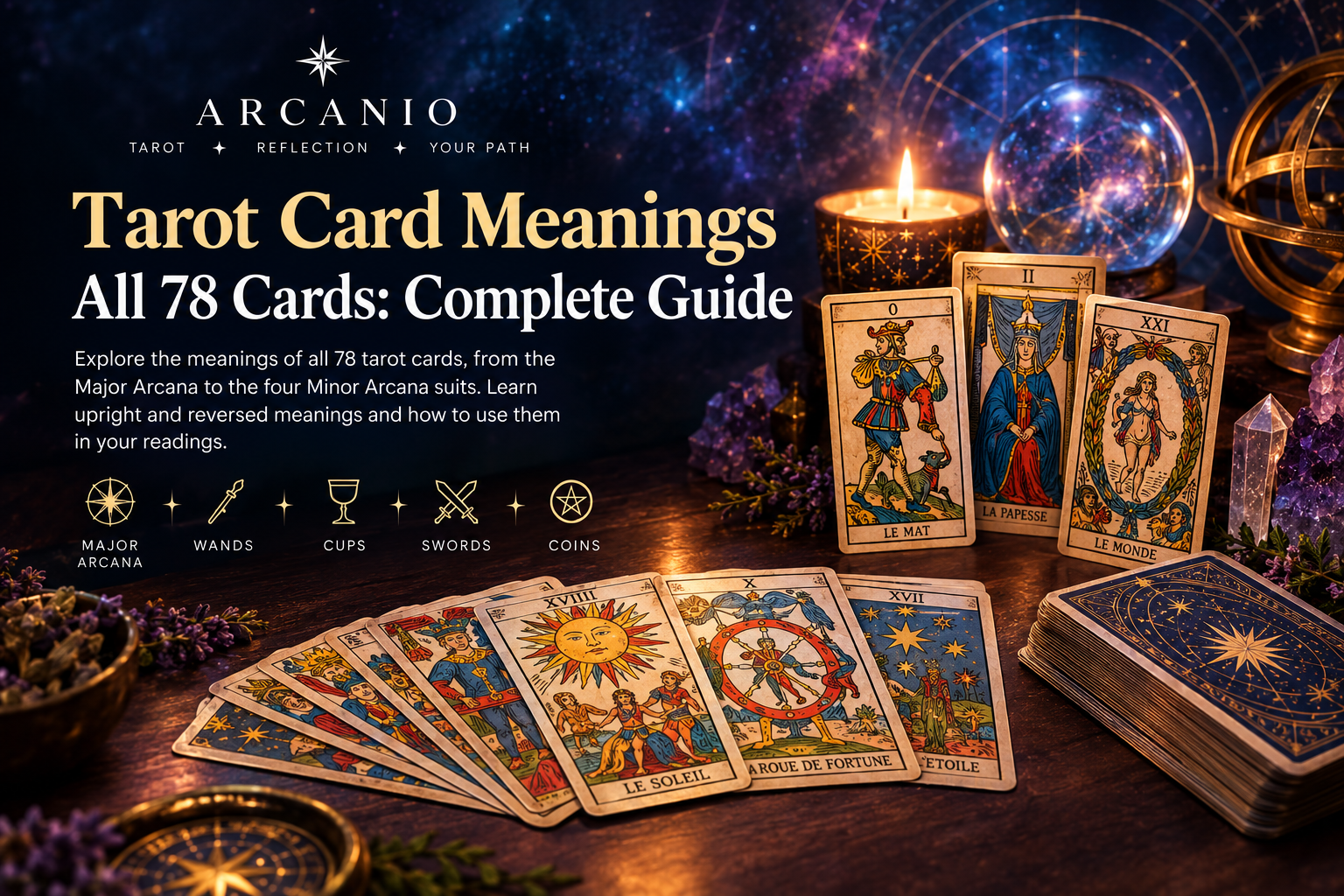
A traditional tarot deck contains 78 cards, divided into the 22 Major Arcana and 56 Minor Arcana. Together, these cards create a symbolic system that can be used for tarot readings, reflection, journaling, personal exploration, and spiritual practice. Arcanio Tarot Card Meanings — All 78 Cards: Complete Guide.
Arcanio's digital deck contains 78 Marseille cards based on the Jean Noblet tarot, Paris, c. 1650, giving you a way to explore the complete deck and its individual cards.
This complete guide explains the tarot card meanings for all 78 cards, including upright and reversed interpretations. It also explains how tarot card meanings work in different readings and how beginners can learn the cards without trying to memorize everything at once.
Tarot meanings are not completely fixed. The meaning of a card can change according to the question, spread position, surrounding cards, imagery, and the reader's interpretation.
What Are the 78 Tarot Cards?
The tarot deck is divided into two major sections: the Major Arcana and the Minor Arcana.
The Major Arcana
The Major Arcana contains 22 cards representing broad symbolic themes, experiences, transitions, challenges, and stages of development.
The cards are:
The Fool, The Magician, The High Priestess, The Empress, The Emperor, The Pope, The Lovers, The Chariot, Justice, The Hermit, The Wheel of Fortune, Strength, The Hanged Man, Death, Temperance, The Devil, The Tower, The Star, The Moon, The Sun, Judgement, and The World.
Arcanio's deck follows the Marseille tradition, so some card names differ from terminology found in modern Rider-Waite-Smith tarot guides.
For example, Arcanio uses The Pope, while many modern tarot systems use The Hierophant.
The Minor Arcana
The Minor Arcana contains 56 cards divided into four suits:
Wands — action, energy, creativity, ambition
Cups — emotions, relationships, intuition, connection
Swords — thoughts, communication, conflict, decisions
Coins — work, resources, money, stability, practical life
Each suit contains ten numbered cards and four court cards: Page, Knight, Queen, and King.
You can explore the complete 78-card Arcanio deck while learning the meanings in this guide.
The 22 Major Arcana Tarot Card Meanings
The Major Arcana often represents larger themes, important transitions, significant choices, and symbolic stages of a journey.
The Fool
Upright: New beginnings, freedom, adventure, spontaneity, innocence, taking a leap of faith.
Reversed: Recklessness, poor planning, impulsiveness, fear of beginning.
The Fool represents the beginning of a journey. It encourages curiosity and openness while reminding you that freedom works best when combined with awareness.
The Magician
Upright: Manifestation, skill, creativity, confidence, communication, personal power.
Reversed: Manipulation, wasted potential, lack of confidence, poor use of abilities.
The Magician represents the ability to turn an idea into action by using the resources and abilities already available to you.
The High Priestess
Upright: Intuition, mystery, inner knowledge, subconscious awareness, patience.
Reversed: Ignoring intuition, hidden information, confusion, secrets.
The High Priestess encourages you to look beneath the obvious and pay attention to what your intuition is telling you.
The Empress
Upright: Abundance, creativity, nurturing, beauty, growth, fertility.
Reversed: Creative block, neglect, dependence, lack of self-care.
The Empress represents growth, nourishment, creativity, and the ability to create an environment where something can develop.
The Emperor
Upright: Structure, authority, leadership, stability, discipline, responsibility.
Reversed: Rigidity, control, domination, insecurity.
The Emperor represents order and structure. It can encourage you to establish boundaries and take responsibility.
The Pope
Upright: Tradition, teaching, guidance, beliefs, institutions, established systems.
Reversed: Questioning tradition, unconventional thinking, rebellion, personal beliefs.
The Pope represents established knowledge and systems of belief. Reversed, it can suggest creating your own path rather than simply following inherited rules.
The Lovers
Upright: Love, partnership, attraction, harmony, choices, alignment.
Reversed: Disharmony, imbalance, separation, conflicting values.
The Lovers is about relationships, but it is also about important choices and whether your actions align with your values.
The Chariot
Upright: Determination, ambition, movement, victory, direction.
Reversed: Lack of direction, aggression, loss of control.
The Chariot represents forward movement through determination and focused effort.
Justice
Upright: Truth, fairness, accountability, balance, decisions.
Reversed: Unfairness, dishonesty, imbalance, avoiding responsibility.
Justice encourages honesty and awareness of consequences.
The Hermit
Upright: Solitude, reflection, wisdom, introspection, searching.
Reversed: Isolation, loneliness, withdrawal, avoiding reflection.
The Hermit asks you to step away from distractions and look inward.
Wheel of Fortune
Upright: Change, cycles, opportunity, turning points, movement.
Reversed: Resistance to change, setbacks, instability, repeating patterns.
The Wheel of Fortune represents cycles and reminds us that circumstances can change.
Strength
Upright: Courage, patience, compassion, confidence, inner strength.
Reversed: Self-doubt, insecurity, emotional weakness.
Strength is about calm control rather than force. It represents courage, patience, and emotional resilience.
The Hanged Man
Upright: Pause, surrender, perspective, patience, letting go.
Reversed: Resistance, delay, indecision, unwillingness to change perspective.
The Hanged Man suggests that stepping back and seeing a situation differently may be more useful than forcing progress.
Death
Upright: Transformation, endings, transition, release, renewal.
Reversed: Resistance to change, attachment, stagnation.
Death is usually symbolic rather than literal. It represents the ending of one chapter and the beginning of another.
Temperance
Upright: Balance, patience, harmony, moderation, integration.
Reversed: Excess, imbalance, impatience, conflict.
Temperance encourages you to combine different parts of your life carefully rather than moving toward extremes.
The Devil
Upright: Attachment, temptation, obsession, materialism, unhealthy patterns.
Reversed: Liberation, awareness, breaking patterns, reclaiming control.
The Devil can highlight habits or attachments that have begun to limit your freedom.
The Tower
Upright: Sudden change, revelation, disruption, collapse, awakening.
Reversed: Resistance, internal upheaval, avoiding change.
The Tower represents structures that can no longer remain stable. Although disruptive, it can also reveal what needs to change.
The Star
Upright: Hope, healing, inspiration, renewal, optimism.
Reversed: Discouragement, hopelessness, self-doubt.
The Star represents renewal and the return of hope after difficulty.
The Moon
Upright: Uncertainty, intuition, dreams, illusion, subconscious emotions.
Reversed: Confusion clearing, hidden information emerging, fear.
The Moon reminds you that appearances can be misleading and that not everything is clear yet.
The Sun
Upright: Joy, clarity, success, confidence, vitality.
Reversed: Temporary uncertainty, delayed success, lack of confidence.
The Sun represents clarity, optimism, confidence, and positive energy.
Judgement
Upright: Awakening, reflection, renewal, calling, evaluation, second chances.
Reversed: Self-criticism, avoidance, doubt, refusing to learn from the past.
Judgement encourages honest reflection and learning from previous experiences.
The World
Upright: Completion, achievement, integration, fulfillment, successful conclusion.
Reversed: Incomplete cycle, delays, lack of closure.
The World represents the completion of a significant cycle and the integration of what you have learned.
Wands Tarot Card Meanings
Wands are commonly associated with action, creativity, passion, ambition, energy, and movement.
Ace of Wands
Upright: Inspiration, new opportunity, passion, creativity, potential.
Reversed: Creative block, lack of motivation, delayed beginning.
The Ace of Wands represents the spark of a new idea or opportunity.
Two of Wands
Upright: Planning, vision, future choices, expansion.
Reversed: Fear of change, poor planning, limited perspective.
The Two of Wands encourages you to think beyond your current situation and consider your next direction.
Three of Wands
Upright: Expansion, progress, anticipation, long-term vision.
Reversed: Delays, limited progress, lack of foresight.
The Three of Wands represents plans beginning to move beyond their starting point.
Four of Wands
Upright: Celebration, stability, community, achievement, home.
Reversed: Instability, tension, incomplete celebration.
The Four of Wands often represents a moment of stability or something worth celebrating.
Five of Wands
Upright: Competition, disagreement, challenge, conflicting opinions.
Reversed: Avoiding conflict, internal tension, resolution.
The Five of Wands can describe friction that forces people to clarify their positions.
Six of Wands
Upright: Recognition, success, confidence, achievement.
Reversed: Lack of recognition, insecurity, delayed success.
The Six of Wands can represent receiving recognition for effort or progress.
Seven of Wands
Upright: Persistence, boundaries, courage, defending yourself.
Reversed: Exhaustion, giving up, feeling overwhelmed.
The Seven of Wands asks whether you are willing to stand behind what matters to you.
Eight of Wands
Upright: Speed, communication, movement, rapid progress.
Reversed: Delays, miscommunication, lack of momentum.
The Eight of Wands represents acceleration and events moving quickly.
Nine of Wands
Upright: Resilience, persistence, caution, endurance.
Reversed: Exhaustion, defensiveness, burnout.
The Nine of Wands represents resilience gained through previous challenges.
Ten of Wands
Upright: Responsibility, pressure, burden, overwork.
Reversed: Releasing burdens, delegation, burnout.
The Ten of Wands asks whether you are carrying more responsibility than you need to carry.
Page of Wands
Upright: Curiosity, exploration, enthusiasm, new ideas.
Reversed: Immaturity, lack of direction, impulsiveness.
The Page of Wands approaches life with curiosity and excitement.
Knight of Wands
Upright: Action, adventure, confidence, passion.
Reversed: Impulsiveness, impatience, recklessness.
The Knight of Wands brings strong momentum, but that energy needs direction.
Queen of Wands
Upright: Confidence, independence, charisma, creativity.
Reversed: Jealousy, insecurity, attention-seeking.
The Queen of Wands represents confidence and the ability to express personal strengths.
King of Wands
Upright: Leadership, vision, ambition, confidence.
Reversed: Arrogance, impatience, authoritarian behavior.
The King of Wands represents leadership guided by vision and action.
Cups Tarot Card Meanings
Cups explore emotions, relationships, intuition, compassion, creativity, and connection.
Ace of Cups
Upright: New emotions, love, compassion, emotional renewal.
Reversed: Emotional blockage, emptiness, suppressed feelings.
The Ace of Cups represents the beginning of a new emotional experience.
Two of Cups
Upright: Partnership, mutual attraction, connection, harmony.
Reversed: Disconnection, imbalance, conflict, separation.
The Two of Cups is strongly associated with meaningful one-to-one relationships.
Three of Cups
Upright: Friendship, celebration, community, joy.
Reversed: Isolation, excess, social tension.
The Three of Cups highlights community, friendship, and shared happiness.
Four of Cups
Upright: Apathy, contemplation, dissatisfaction, missed opportunities.
Reversed: Renewed interest, awareness, emotional movement.
The Four of Cups can appear when an opportunity exists but attention is focused elsewhere.
Five of Cups
Upright: Loss, disappointment, grief, regret.
Reversed: Acceptance, recovery, moving forward.
The Five of Cups asks you to acknowledge disappointment without overlooking what remains.
Six of Cups
Upright: Nostalgia, memories, childhood, kindness.
Reversed: Living in the past, unresolved memories.
The Six of Cups connects the present with emotional memories from the past.
Seven of Cups
Upright: Choices, imagination, possibilities, illusion.
Reversed: Clarity, realistic thinking, narrowed choices.
The Seven of Cups reminds you that having many possibilities does not automatically make choosing easier.
Eight of Cups
Upright: Walking away, emotional transition, leaving something behind.
Reversed: Fear of leaving, avoidance, returning.
The Eight of Cups represents the decision to search for something deeper or more meaningful.
Nine of Cups
Upright: Satisfaction, pleasure, wishes, emotional fulfillment.
Reversed: Dissatisfaction, excess, shallow fulfillment.
The Nine of Cups asks what genuinely makes you feel fulfilled.
Ten of Cups
Upright: Emotional fulfillment, family, harmony, belonging.
Reversed: Family tension, broken expectations, emotional imbalance.
The Ten of Cups represents emotional harmony and a sense of belonging.
Page of Cups
Upright: Sensitivity, intuition, creativity, emotional openness.
Reversed: Emotional immaturity, insecurity, blocked creativity.
The Page of Cups approaches emotions with curiosity and openness.
Knight of Cups
Upright: Romance, idealism, emotional expression, invitation.
Reversed: Unrealistic expectations, moodiness, emotional avoidance.
The Knight of Cups follows the heart and can represent an emotional message or opportunity.
Queen of Cups
Upright: Compassion, intuition, emotional intelligence, empathy.
Reversed: Emotional overwhelm, insecurity, poor boundaries.
The Queen of Cups represents emotional understanding and empathy.
King of Cups
Upright: Emotional maturity, calmness, compassion, wisdom.
Reversed: Emotional suppression, manipulation, instability.
The King of Cups represents emotional strength combined with calm judgment.
Swords Tarot Card Meanings
Swords are associated with thoughts, communication, truth, decisions, conflict, anxiety, and mental processes.
Ace of Swords
Upright: Clarity, truth, breakthrough, new idea.
Reversed: Confusion, misinformation, unclear thinking.
The Ace of Swords represents a moment of mental clarity.
Two of Swords
Upright: Indecision, difficult choice, avoidance, stalemate.
Reversed: Information emerging, decision, confusion.
The Two of Swords often appears when a decision has been postponed.
Three of Swords
Upright: Heartbreak, grief, disappointment, painful truth.
Reversed: Healing, forgiveness, recovery.
The Three of Swords represents emotional pain and the process of confronting it.
Four of Swords
Upright: Rest, recovery, pause, contemplation.
Reversed: Restlessness, burnout, inability to recover.
The Four of Swords encourages stepping away from constant activity.
Five of Swords
Upright: Conflict, competition, tension, hollow victory.
Reversed: Reconciliation, regret, releasing conflict.
The Five of Swords asks whether winning an argument is worth its consequences.
Six of Swords
Upright: Transition, moving forward, leaving difficulty behind.
Reversed: Resistance, unfinished transition, returning.
The Six of Swords represents movement from difficulty toward something calmer.
Seven of Swords
Upright: Strategy, secrecy, independence, avoidance.
Reversed: Exposure, confession, accountability.
The Seven of Swords can suggest that something is happening indirectly rather than openly.
Eight of Swords
Upright: Restriction, fear, self-limitation, feeling trapped.
Reversed: Freedom, new perspective, breaking limiting beliefs.
The Eight of Swords often points toward limitations created or reinforced by perception.
Nine of Swords
Upright: Anxiety, worry, fear, sleeplessness.
Reversed: Recovery, confronting fears, reduced anxiety.
The Nine of Swords represents thoughts that have become difficult to switch off.
Ten of Swords
Upright: Ending, collapse, painful conclusion, finality.
Reversed: Recovery, survival, rebuilding.
The Ten of Swords can mark the end of an extremely difficult chapter.
Page of Swords
Upright: Curiosity, observation, communication, learning.
Reversed: Gossip, impulsive communication, lack of focus.
The Page of Swords wants information and asks questions.
Knight of Swords
Upright: Determination, speed, direct communication, action.
Reversed: Aggression, impatience, reckless decisions.
The Knight of Swords moves quickly and decisively.
Queen of Swords
Upright: Independence, clarity, honesty, intelligence, boundaries.
Reversed: Bitterness, excessive criticism, emotional distance.
The Queen of Swords represents clear thinking and strong personal boundaries.
King of Swords
Upright: Logic, authority, truth, analytical thinking.
Reversed: Manipulation, coldness, misuse of authority.
The King of Swords represents disciplined thinking and rational judgment.
Coins Tarot Card Meanings
Arcanio's Marseille deck uses Coins for the fourth suit. Many modern tarot systems call this suit Pentacles.
Coins are associated with practical life, work, money, resources, stability, and material reality.
Ace of Coins
Upright: New opportunity, prosperity, career opportunity, practical beginning.
Reversed: Missed opportunity, financial instability, poor planning.
The Ace of Coins represents a tangible opportunity with potential for long-term development.
Two of Coins
Upright: Balance, flexibility, multitasking, adaptation.
Reversed: Overload, disorganization, imbalance.
The Two of Coins asks how effectively you are managing competing responsibilities.
Three of Coins
Upright: Teamwork, skill, collaboration, craftsmanship.
Reversed: Poor teamwork, lack of recognition, low-quality work.
The Three of Coins highlights what can be achieved through cooperation and developing expertise.
Four of Coins
Upright: Security, saving, control, possession, stability.
Reversed: Letting go, financial insecurity, excessive attachment.
The Four of Coins can represent the desire to protect what you have.
Five of Coins
Upright: Hardship, financial difficulty, insecurity, exclusion.
Reversed: Recovery, support, improvement.
The Five of Coins represents difficult circumstances and the importance of recognizing available support.
Six of Coins
Upright: Generosity, support, giving, receiving, balance.
Reversed: Unequal exchange, debt, dependence.
The Six of Coins explores the balance between giving and receiving.
Seven of Coins
Upright: Patience, investment, assessment, long-term growth.
Reversed: Impatience, frustration, poor return.
The Seven of Coins asks whether your current effort is producing the results you want.
Eight of Coins
Upright: Skill development, practice, dedication, craftsmanship.
Reversed: Lack of focus, repetitive work, perfectionism.
The Eight of Coins is the card of improving through consistent practice.
Nine of Coins
Upright: Independence, achievement, comfort, self-sufficiency.
Reversed: Dependence, financial setbacks, isolation.
The Nine of Coins represents the rewards of developing independence and stability.
Ten of Coins
Upright: Legacy, family, wealth, stability, long-term security.
Reversed: Financial instability, family conflict, disrupted plans.
The Ten of Coins looks beyond immediate success toward lasting foundations.
Page of Coins
Upright: Learning, opportunity, ambition, practical goals.
Reversed: Lack of commitment, procrastination, missed opportunities.
The Page of Coins approaches practical life as a student.
Knight of Coins
Upright: Reliability, patience, consistency, responsibility.
Reversed: Stagnation, stubbornness, boredom.
The Knight of Coins reminds you that steady progress can be more valuable than speed.
Queen of Coins
Upright: Practicality, nurturing, stability, resourcefulness.
Reversed: Neglect, work-life imbalance, insecurity.
The Queen of Coins combines practical intelligence with care and stability.
King of Coins
Upright: Success, stability, wealth, leadership, security.
Reversed: Materialism, greed, financial instability.
The King of Coins represents established resources and practical leadership.
How to Read Tarot Card Meanings
Knowing keywords is only the beginning.
A good tarot reading does not simply copy a dictionary definition. Start with the question, look at the card's imagery, consider what immediately catches your attention, and then connect the traditional meaning with the position in the spread.
For example, The Hermit in a career reading might suggest independent study, stepping back from workplace noise, or seeking professional wisdom.
The same card in a relationship reading could suggest needing space, reflection, or deeper understanding.
The card has not changed.
The context has changed. Free tarot reading Here.
Upright and Reversed Tarot Card Meanings
Some tarot readers use reversals and others read every card upright.
Both approaches can work.
A reversed card can represent blocked energy, internalized energy, delay, resistance, or a different expression of the upright meaning.
It does not automatically mean something negative.
If you are a beginner, you can start with upright cards and introduce reversals later.
Arcanio's digital reading experience also incorporates card orientation as part of its card-selection process.
One Card Tarot Reading
You do not need a complicated spread to begin learning tarot.
A One Card Tarot reading gives you one central theme and can be particularly useful for beginners, daily reflection, and learning individual card meanings.
For a deeper explanation, continue with Arcanio's One Card Tarot guide.
A simple daily question could be:
What should I pay attention to today?
Draw one card, observe its imagery, write down your first reaction, and then compare your interpretation with the traditional meaning.
Three Card Tarot Reading
A three-card reading provides more context than a single card.
One of the most popular structures is:
Card 1 — Past
Card 2 — Present
Card 3 — Future
Another useful structure is:
Situation — Challenge — Guidance
The cards should be interpreted together rather than as three completely separate answers.
You can learn more through Arcanio's Three Card Tarot Reading guide.
Past Present Future Tarot Spread
The Past Present Future Tarot Spread is one of the simplest ways to understand how multiple tarot cards interact.
The first card provides context from the past.
The second focuses attention on the present.
The third explores the direction or possibility represented by the future position.
It is important not to treat the future card as an unavoidable prediction. Tarot can be used as a symbolic tool for exploring possibilities rather than guaranteeing a particular outcome.
How to Learn All 78 Tarot Card Meanings
Trying to memorize all 78 cards at once can feel overwhelming.
Start with the Major Arcana.
Then learn the four Minor Arcana suits.
Remember:
Wands = energy and action
Cups = emotion and relationships
Swords = thought and decisions
Coins = practical and material life
Then study the numbers and court cards.
You can also practice with one card at a time instead of trying to memorize an entire deck.
A Simple Daily Tarot Practice
Draw one card each day.
Before looking up the meaning, study the image.
Ask yourself:
What do I notice first?
What emotion does the card create?
What symbols stand out?
What story does the card appear to tell?
How could this relate to my day?
Then compare your observations with traditional meanings.
Keeping a tarot journal can help you discover personal patterns over time.
Tarot Card Meanings and Quantum Tarot
Arcanio takes a modern approach to digital card selection through its quantum-based shuffle experience.
This creates an interesting connection between traditional tarot symbolism and modern technology.
The technology determines how cards are selected.
The tarot cards provide the symbolic language.
The reader interprets the result.
This does not mean that quantum physics scientifically proves tarot or that quantum randomness makes a tarot reading objectively more accurate.
Instead, it is a technological approach to random card selection within a digital tarot experience.
You can explore the concept further through Arcanio's Quantum Tarot guide and Quantum Randomness and Tarot article.
Quantum Tarot vs Traditional Tarot
Traditional tarot commonly involves physically shuffling, cutting, and drawing cards.
Digital tarot can reproduce the selection process through software and other forms of randomness.
Neither approach has to replace the other.
A physical deck can provide a tactile ritual, while digital tarot can provide accessibility and convenience.
Arcanio explores this difference in its Quantum Tarot vs Traditional Tarot guide.
Tarot Shuffling and Card Selection
Shuffling is one of the most recognizable parts of a traditional tarot reading.
Different readers use different techniques, including overhand shuffling, riffle-style approaches, cutting, spreading, and other personal methods.
If you want to explore the practical side of physical tarot, Arcanio's Best Tarot Shuffling Techniques guide provides a natural next step.
Digital tarot approaches card selection differently, but the basic purpose remains similar: creating a process through which cards can be selected without the reader simply choosing the desired result.
What Makes Arcanio's 78-Card Deck Different?
Arcanio presents a Jean Noblet tarot based on a Parisian deck from around 1650, giving the digital experience a historical Marseille foundation.
This also explains why you may see terminology that differs from some modern tarot guides.
For example:
The Pope may appear where another system says The Hierophant.
Coins may appear where another system says Pentacles.
Understanding these differences is important when comparing tarot sources online.
Tarot as a Tool for Reflection
Whether someone approaches tarot spiritually, symbolically, creatively, or psychologically, the cards can provide a framework for asking questions.
A reading can encourage you to slow down and consider possibilities that you might otherwise overlook.
For example:
What am I avoiding?
What do I really want?
What pattern keeps repeating?
What choice am I struggling with?
What could I learn from this situation?
The value of a reading does not require every card to be treated as a literal prediction.
Tarot can instead function as a structured way to explore ideas, emotions, possibilities, and personal narratives.
Explore All 78 Tarot Cards With Arcanio
Learning tarot becomes more interesting when the cards become part of a larger personal system.
Instead of treating each card as an isolated definition, you can explore how cards relate to questions, readings, patterns, and personal Arcana.
Arcanio combines a digital tarot experience with a historical 78-card Marseille deck and personalized Arcana features.
If you are starting with tarot card meanings, the Arcanio 78-card deck is the best place to browse the cards themselves.
From there, you can explore One Card Tarot, Three Card Tarot, Quantum Tarot, tarot shuffling, and other approaches to digital tarot.
Final Thoughts on Tarot Card Meanings
The 78 tarot cards form a large symbolic system.
The 22 Major Arcana explore broad themes, archetypes, transitions, and major experiences.
The 56 Minor Arcana bring those themes into everyday life through Wands, Cups, Swords, and Coins.
But learning tarot is not simply memorizing 78 definitions.
The question matters.
The card position matters.
The surrounding cards matter.
The imagery matters.
And your interpretation matters.
Use traditional tarot meanings as a foundation, then develop your own ability to recognize patterns and stories.
If you want to explore the complete deck visually, visit the Arcanio 78-card deck.
If you want a simple reading, explore One Card Tarot.
If you want more context, try a Three Card Tarot Reading.
If you are interested in the technology behind digital tarot, explore Quantum Tarot and Quantum Randomness and Tarot.
And if you want to understand physical card selection, explore Best Tarot Shuffling Techniques.
Your tarot journey does not require you to know everything before you begin.
Start with one card.
Ask one question.
Look closely.
And let the symbolism give you something to think about.
The conversation
Be the first to say something
Comments are open to anyone with an account — it keeps the thread honest and your comments yours. It takes a moment and the weekly reading comes with it.