How to Do a Three Card Tarot Spread? Tarot can be a powerful tool for reflection, self-discovery, and exploring the questions that matter most to you. If you are new to tarot, one of the easiest and most useful layouts to learn is the three card tarot spread.
A three card tarot spread uses just three cards, making it simple enough for beginners while still offering meaningful insight. You can use the cards to explore the past, present, and future, understand a situation, reflect on relationships, or gain a different perspective on an important question.
In this guide, you will learn how to do a three card tarot spread, how to choose your question, how to draw and interpret the cards, and how to connect the three cards into one meaningful reading.
What Is a Three Card Tarot Spread?
A three card tarot spread is a tarot reading that uses three cards placed next to each other in a specific order. Each position has a particular meaning, and the three cards work together to create a complete interpretation.
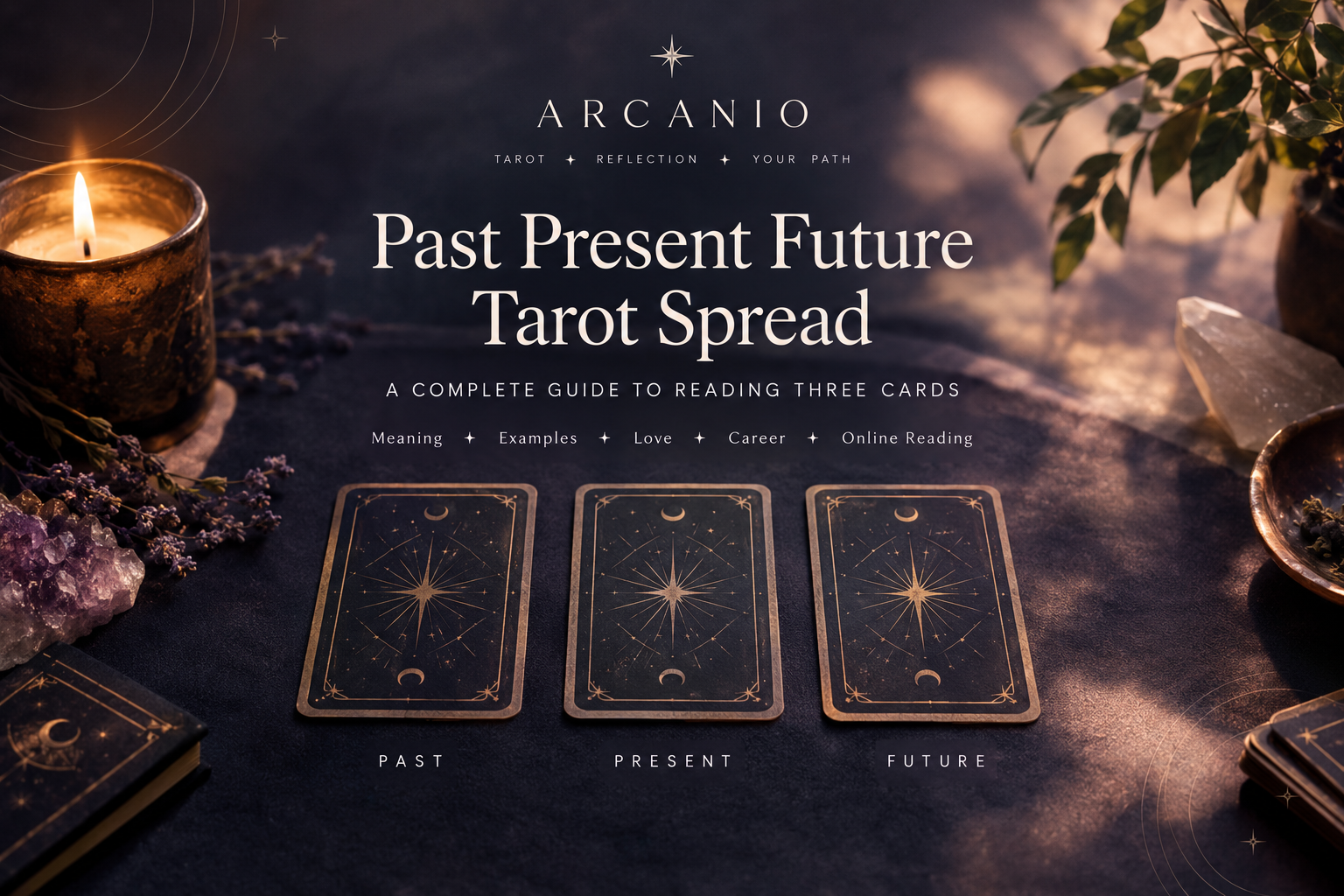
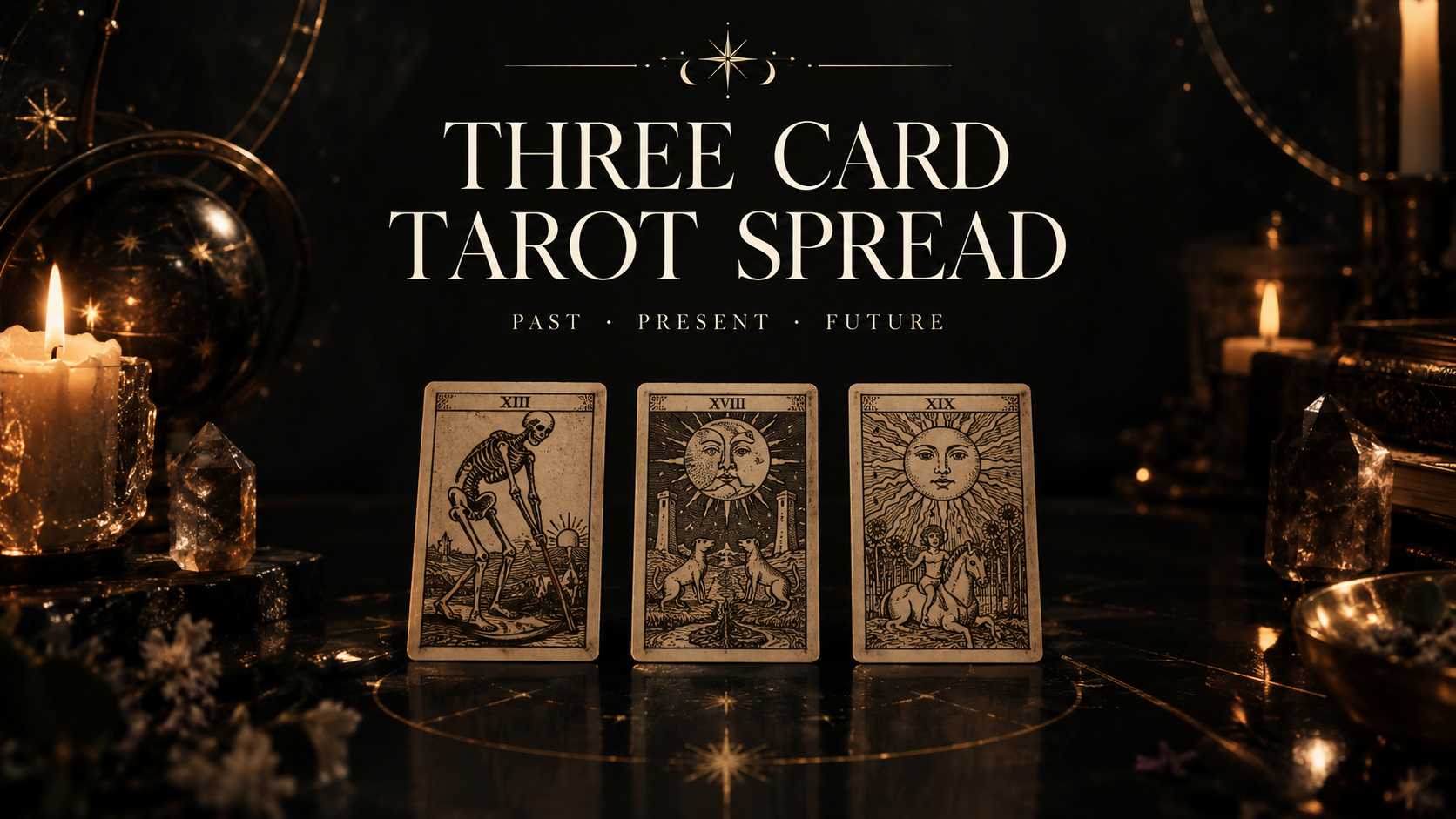
One of the most popular versions is the past present future tarot spread:
Card One — Past
Card Two — Present
Card Three — Future
However, there is no single rule that says these must always represent past, present, and future. You can create a three card tarot reading around almost any subject.
For example, you could use:
Situation, Challenge, Advice
Mind, Body, Spirit
What I know, What I don't know, What I need to know
Problem, Action, Outcome
You, The other person, The relationship
Past influence, Current energy, Possible direction
The simplicity of the layout is what makes the 3 card tarot spread so popular.
Why Use a Three Card Tarot Reading?
A three card tarot reading is useful because it gives you enough information to explore a situation without overwhelming you with too many cards.
Large tarot spreads can contain ten or more cards. While these spreads can provide detailed interpretations, beginners may find them difficult to connect into a coherent story.
Three cards provide a middle ground.
You have:
A clear structure
Enough information to explore a situation
Fewer cards to interpret
An easy layout to remember
A reading that can be completed in just a few minutes
The three cards can also be viewed as a conversation. Instead of interpreting each card separately, consider how the cards influence one another.
For example, if the first card represents a past experience, the second represents your current situation, and the third represents a possible direction, you can ask:
How did the first card lead to the second?
Then:
What does the second card suggest about the third?
This approach transforms three individual cards into a connected story.
How to Do a Three Card Tarot Spread
You don't need an elaborate ritual or a special location to perform a three card tarot reading. What matters most is creating a moment where you can focus on your question.
Follow these simple steps.
1. Choose a Clear Question
Before drawing your cards, decide what you want to explore.
A clear question generally produces a more focused reading.
Instead of asking:
"What will happen?"
you might ask:
"What should I understand about my current situation?"
Or:
"What can I learn from this relationship?"
Other useful questions include:
What should I focus on right now?
What is influencing my current situation?
What challenge should I pay attention to?
What can I learn from my recent experience?
What energy surrounds my current decision?
What perspective might help me move forward?
Try to avoid asking the same question repeatedly in a short period simply because you did not receive the answer you expected.
Tarot works best as a reflective practice rather than a way to force a particular answer.
2. Create a Calm Environment
Find a comfortable place where you can concentrate.
You may want to dim the lights, light a candle, play quiet music, or simply sit somewhere peaceful. These things are optional. The purpose is to help you become present and focused.
Take a few slow breaths before beginning.
Think about your question and allow your attention to settle on it.
3. Shuffle the Tarot Cards
Shuffle your tarot deck in whatever way feels natural to you.
There is no universally correct method for shuffling.
You can shuffle traditionally, spread the cards across a table, or use another method that feels comfortable.
While shuffling, keep your question in mind.
When you feel ready, stop.
4. Draw Three Cards
Draw three cards and place them from left to right.
For a traditional past present future tarot reading, arrange them like this:
Card 1 → Card 2 → Card 3
Past → Present → Future
Take a moment to look at all three cards before interpreting them.
Notice your immediate reactions.
Which card attracts your attention first?
Do any cards share similar symbols, colors, numbers, or themes?
Are there several Major Arcana cards?
Are most of the cards from the same suit?
These observations can provide useful context.
5. Interpret the First Card
Start with the first card.
If you are using a past-present-future spread, this card represents the past or a previous influence connected to your question.
Ask yourself:
What does this card traditionally represent?
How could its meaning relate to my past?
What experience might it describe?
Does the imagery remind me of something specific?
How could this past influence affect the present?
Don't worry about finding one "perfect" interpretation.
Tarot cards can have several layers of meaning, and the question provides important context.
6. Interpret the Second Card
Next, look at the second card.
In a three card tarot spread, this is often the most important card because it represents the present situation.
Consider:
What is happening right now?
What energy surrounds the situation?
What am I currently experiencing?
What might I be overlooking?
How does this card connect with the first card?
Pay particular attention to connections between Cards One and Two.
Perhaps the first card describes uncertainty while the second represents clarity. Perhaps the first represents conflict while the second represents healing.
The relationship between the cards can be just as meaningful as the individual meanings.
7. Interpret the Third Card
Finally, examine the third card.
In a past-present-future reading, the third card represents the future or possible direction.
It is helpful to think of this card as a potential path rather than an unavoidable prediction.
Ask:
What direction does this card suggest?
What lesson might it highlight?
What could develop if the current situation continues?
What action or mindset could be useful?
How does this card complete the story?
This approach keeps the reading focused on reflection and possibilities.
Understanding the Past, Present, Future Tarot Spread
The past present future tarot layout is one of the most recognizable three-card spreads.
Its structure is straightforward.
Card One: The Past
The first card represents experiences, influences, or patterns that have contributed to your current situation.
It does not necessarily have to describe a literal event.
It could represent an emotion, belief, relationship, decision, or recurring pattern.
Card Two: The Present
The second card represents your current circumstances.
This may describe your emotions, environment, challenges, opportunities, or the central energy surrounding your question.
Card Three: The Future
The third card represents a possible direction based on the current circumstances.
Rather than treating it as a fixed prediction, consider what the card reveals about potential developments and choices.
Your actions and circumstances can change over time.
How to Read the Three Cards Together
One of the biggest mistakes beginners make is reading each card independently.
A good three card tarot reading is more than three separate definitions.
Think of the spread as a sentence.
The first card introduces the situation.
The second develops it.
The third shows where the story may lead.
For example, imagine a hypothetical reading containing:
The Hermit → The Chariot → The Sun
You might interpret this as a progression from introspection, toward determined movement, toward greater clarity and optimism.
The meaning comes from the relationship between the cards.
You can also look for repeating patterns.
Look at the Suits
If several cards belong to the same suit, that suit may deserve additional attention.
For example:
Cups often relate to emotions and relationships.
Swords are commonly associated with thoughts, communication, and conflict.
Wands often relate to creativity, action, motivation, and ambition.
Pentacles frequently relate to practical matters, work, resources, and material concerns.
These associations can help you identify themes within your spread.
Look at the Major Arcana
If one or more Major Arcana cards appear, consider whether the reading is highlighting a larger life theme or significant personal lesson.
If all three cards are Major Arcana, you may want to spend additional time reflecting on the broader message of the reading.
Look for Repeated Numbers
Numbers can also create connections between cards.
For example, several cards with similar numbers may suggest a recurring stage or pattern.
Don't treat numerical symbolism as an absolute rule. Use it as another layer of interpretation.
Should You Read Reversed Tarot Cards?
Some tarot readers use reversed cards, while others read only upright cards.
A reversed card appears upside down when drawn from the deck.
Depending on the reader, a reversal may represent:
Blocked energy
Internalized energy
A different expression of the card
Delay
Reflection
An alternative interpretation
There is no requirement to use reversals.
If you are a beginner, you may find it easier to start with upright cards and learn the basic meanings first.
Once you become comfortable with the deck, you can experiment with reversed interpretations.
Three Card Tarot Spread Ideas
Once you understand the basic layout, you can experiment with different versions of the 3 card tarot spread.
Situation, Challenge, Advice
This is useful when you are dealing with a specific problem.
Card 1: What is the situation?
Card 2: What is the main challenge?
Card 3: What advice or perspective may help?
You, Them, Relationship
This can be used for relationship reflection.
Card 1: Your perspective or energy
Card 2: The other person's perspective or energy
Card 3: The relationship dynamic
Remember that tarot should not be treated as a way to know another person's private thoughts or feelings with certainty.
Problem, Action, Outcome
This spread can help you explore a decision.
Card 1: What is the central problem?
Card 2: What action or approach should I consider?
Card 3: What possible outcome could develop?
Mind, Body, Spirit
This is a simple reflective spread.
Card 1: Mind
Card 2: Body
Card 3: Spirit
It can be used as a journaling exercise to consider different areas of your life.
Common Mistakes When Doing a Three Card Tarot Spread
Beginners sometimes make the process more complicated than it needs to be.
One common mistake is drawing too many extra cards.
If the original three cards seem confusing, it can be tempting to keep drawing cards until you find an answer that feels comfortable.
Instead, spend more time examining the original spread.
Another mistake is relying entirely on memorized card meanings.
Tarot symbolism becomes more useful when you combine traditional meanings with the context of your question and your own observations.
It is also helpful to avoid treating a tarot reading as an absolute prediction.
The cards can provide a framework for reflection, but your decisions remain your own.
Keep a Tarot Journal
A tarot journal can dramatically improve your understanding of the cards.
After completing a three card tarot spread, write down:
Your question
The date
The three cards
Whether cards were upright or reversed
Your first impressions
Your interpretation
Any symbols you noticed
How you felt during the reading
Later, you can return to your previous readings and reflect on what you learned.
Over time, you may develop a much more personal understanding of the tarot cards.
Try a Three Card Tarot Reading Online
If you want to explore tarot without manually shuffling a physical deck, you can also use an online tarot experience.
You can explore your tarot journey at Arcanio, where you can discover tarot-related insights and explore your arcain experience.
An online reading can be a convenient way to practice different spreads and reflect on the questions you have in mind.
Whether you use a physical deck or an online tarot tool, the most important part is the reflection you bring to the reading.
Final Thoughts
Learning how to do a three card tarot spread is one of the simplest ways to begin working with tarot.
The basic process is easy:
Choose a clear question.
Focus your attention.
Shuffle your cards.
Draw three cards.
Assign each card a position.
Interpret each card.
Look at the connections between them.
Reflect on the overall message.
The classic past present future tarot spread is a great starting point, but don't feel limited to it. As you become more comfortable, experiment with different three-card layouts for relationships, decisions, personal reflection, challenges, and everyday questions.
Most importantly, allow the reading to be a conversation with yourself rather than a rigid prediction of what must happen.
A three card tarot spread is powerful precisely because it is simple. Three cards can give you a structured way to pause, reflect, recognize patterns, and consider possibilities.
If you're ready to explore tarot further, visit Arcanio and begin your own tarot journey.
The conversation
Be the first to say something
Comments are open to anyone with an account — it keeps the thread honest and your comments yours. It takes a moment and the weekly reading comes with it.