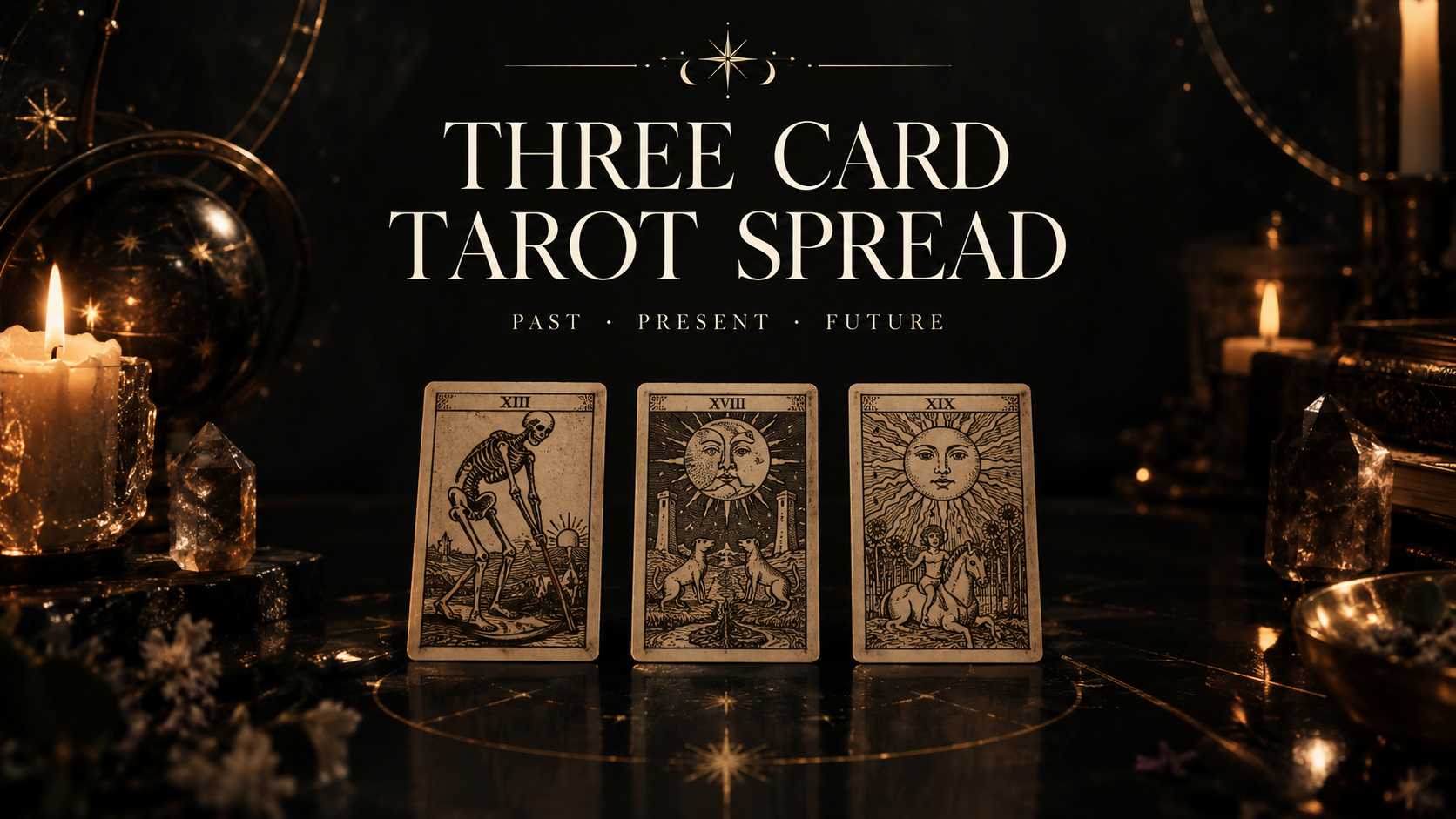
Have you ever wished you could get a clear tarot reading without using a complicated ten-card spread? A three card tarot spread may be exactly what you are looking for. Simple enough for beginners and flexible enough for experienced tarot readers, this classic spread can help you explore where a situation came from, what is happening now, and where it may be heading. use Arcanio we have free three cards tarot for you! in this article we learn Three Card Tarot Reading.
A three card tarot reading can be especially useful when you want a focused perspective on a question without becoming overwhelmed by too many cards. One of the most popular versions is the past present future tarot spread, where each card represents a different stage of your journey.
The beauty of a 3 card tarot spread is its simplicity. You do not need dozens of cards to explore an important question. Instead, three carefully positioned cards can create a complete narrative.
Whether you are curious about love, career, personal growth, relationships, or your next chapter, a three card tarot spread can give you a focused way to reflect on your situation.
If you are ready to explore your own tarot journey, you can also discover the tarot experience at Arcanio and explore your Arcana in a more immersive way.
What Is a Three Card Tarot Spread And how Three Card Tarot Reading work?
A three card tarot spread is a tarot reading that uses three cards, with each card assigned a specific position or role.
The most familiar version is:
Card One — Past
Card Two — Present
Card Three — Future
The cards are usually placed from left to right. You then interpret each card according to its position and, most importantly, consider how all three cards connect.
This last part is important.
A three-card reading is not simply three individual card meanings placed next to one another. Instead, the cards can be viewed as three chapters of the same story.
The first card can show what has influenced your current situation. The second can describe what is happening now. The third can represent the direction the situation may take if the current energy continues.
That makes the three card tarot spread particularly useful when you want perspective rather than a complicated reading.
Why Use a Three Card Tarot Spread? and Three Card Tarot Reading
There are several reasons this spread works so well.
First, it is easy to understand. You do not need to memorize ten or fifteen different positions.
Second, it is focused. Because you only have three cards, there is less information competing for your attention.
Third, it is flexible. You can use the same three-card structure for love, career, personal development, decision-making, daily reflection, and many other questions.
Finally, three cards naturally create a beginning, middle, and possible next chapter.
That is why the past present future tarot format remains one of the most popular ways to approach a simple tarot reading.
If you are new to tarot, starting with three cards can also make the experience feel much less intimidating. Instead of trying to understand a large spread all at once, you can concentrate on three cards and the story they create together.
How Does a 3 Card Tarot Spread Work?
The basic process is straightforward.
Begin by thinking about a situation or question you want to explore. Then shuffle your tarot deck while keeping that question in mind.
Once you feel ready, draw three cards.
Place them in a line:
Past → Present → Future
The first card represents something from the past that may have shaped the current situation.
The second card represents the present circumstances, emotions, patterns, or energy surrounding your question.
The third card represents the potential direction of the situation.
However, it is useful to think of the future position as a direction rather than an unchangeable prediction.
Your choices, actions, circumstances, and new information can all influence what happens next.
Therefore, a Three Card Tarot Reading can be approached as a tool for reflection and self-exploration rather than a guarantee of a specific future event.
Understanding the Past, Present and Future Positions
The three positions are simple, but each can be interpreted at several levels.
Let's look at each one in detail.
Card One in Three Card Tarot Reading: The Past
The first card in a three card tarot spread represents the past.
That does not necessarily mean something that happened yesterday or last week.
Instead, the Past card can represent an earlier event, relationship, decision, belief, emotional pattern, or experience that continues to influence your current situation.
For example, imagine you ask:
"What do I need to understand about my career right now?"
You draw a card associated with patience and long-term effort in the Past position.
This could encourage you to consider whether your current career situation has been shaped by years of persistence, delayed rewards, or a decision to prioritize stability.
The Past card gives your reading context.
Questions to Ask About the Past Card
When interpreting this position, ask yourself:
What happened before this situation?
What experience brought me here?
What pattern might still be influencing me?
What lesson from the past is relevant now?
Is something from the past still unresolved?
What have I already learned from this experience?
The goal is not to become trapped in the past.
Instead, you are looking for the connection between the past and the present.
Card Two in Three Card Tarot Reading: The Present
The second card is the center of your past present future tarot reading.
It represents your current situation.
This may include your emotional state, the circumstances around you, an opportunity, an obstacle, a relationship dynamic, or a pattern that deserves your attention.
Because it sits in the middle, the Present card often acts as the bridge between the other two cards.
It can show what is happening now and help explain how the past is influencing the direction ahead.
For example, suppose your Past card suggests a period of major change, while your Present card represents uncertainty.
Together, these cards might encourage you to consider whether the uncertainty you currently feel is connected to a recent transition.
Questions to Ask About the Present Card
Consider asking:
What is happening in my life right now?
What deserves my attention?
What am I currently experiencing?
What opportunity is available?
What challenge am I facing?
What might I be overlooking?
What can I learn from my current circumstances?
The Present card is often the most important card to examine carefully because it represents the point where your choices can influence what comes next.
Card Three in Three Card Tarot Reading: The Future
The third card represents the Future.
This is often the position people are most curious about.
However, the Future card should not automatically be treated as a fixed prediction.
Instead, consider it a possible direction or trajectory.
Ask yourself:
"If the current situation continues, what direction might it take?"
For example, a card associated with expansion might suggest new possibilities. A card associated with conflict might encourage you to pay attention to tension or communication. A card associated with completion could indicate that a chapter is approaching its natural conclusion.
The meaning depends heavily on the question, the other cards, and the context of the reading.
Questions to Ask About the Future Card
You can ask:
Where does the current situation appear to be heading?
What possibility could develop?
What should I prepare for?
What energy might become more important?
What can I do now to influence the direction?
What lesson might the future position be highlighting?
This approach makes your three card tarot reading more useful because it brings the focus back to awareness and personal choice.
How to Read a Three Card Tarot Spread as One Story
One of the biggest mistakes beginners make is reading each card separately.
For example:
Card One means X.
Card Two means Y.
Card Three means Z.
That approach can produce a list of meanings, but it may miss the deeper story.
Instead, try reading the cards as a sequence.
Imagine that the three cards are three scenes in a movie.
The first scene establishes what happened.
The second scene shows where the character is now.
The third scene suggests where the story could go next.
Now ask:
How does Card One lead into Card Two?
Then ask:
How does Card Two lead into Card Three?
Finally, ask:
What is the overall message of all three cards together?
This simple technique can transform your 3 card tarot spread from three disconnected definitions into a coherent reading.
Look for Repeating Themes
Pay attention to patterns.
Do several cards contain similar symbols?
Are multiple cards from the same suit?
Do you see several Major Arcana cards?
Is there a repeated emotional theme?
For example, if all three cards relate to communication, relationships, or change, that theme may deserve extra attention.
You can also notice contrasts.
A peaceful Past card followed by a difficult Present card may tell a different story from a difficult Past card followed by a hopeful Present card.
The relationship between the cards matters.
How to Do a Three Card Tarot Reading Step by Step
You can perform a three card tarot reading in just a few minutes.
Here is a simple process.
Step 1: Choose Your Question
Start with one clear question.
Specific questions generally give you more useful material to reflect on than extremely broad questions.
Instead of asking:
"What is going to happen to me?"
Try:
"What should I understand about my current career situation?"
Or:
"What can I learn about the direction of my relationship?"
Or:
"What should I focus on as I begin this new chapter?"
Open-ended questions can give you more room for reflection.
Step 2: Choose Your Spread
For the classic past present future tarot reading, assign:
Card 1 — Past
Card 2 — Present
Card 3 — Future
Decide what each position means before drawing your cards.
That prevents you from changing the meaning of a position after seeing the card.
Step 3: Shuffle Your Cards
Shuffle your tarot deck in whatever way feels comfortable.
There is no single required shuffling technique.
Some readers shuffle traditionally. Others spread the cards across a surface and mix them. Some cut the deck before drawing.
The important part is creating a moment where you can focus on your question.
Step 4: Draw Three Cards
Draw three cards and place them from left to right.
Do not rush to interpret them.
Take a moment to observe the imagery.
What is the first thing you notice?
Does a particular symbol immediately attract your attention?
What emotion does the card create?
Your first impression can be useful before you consult traditional meanings.
Step 5: Interpret Each Card
Now consider each card according to its position.
Remember that the same card can have different implications depending on whether it appears in the Past, Present, or Future position.
A card representing change in the Past could describe a transformation you have already experienced.
The same card in the Future position might suggest that change is becoming an important theme.
Context matters.
Step 6: Connect the Cards
Now read all three cards together.
Ask:
What story are these cards telling?
Look for a progression.
Perhaps the Past shows uncertainty, the Present shows learning, and the Future shows confidence.
That creates a very different narrative from Past confidence, Present confusion, and Future uncertainty.
The cards become more meaningful when you look at the relationships between them.
Step 7: Write Down Your Interpretation
If possible, record your reading.
Write down:
Your original question
The three cards
Your first impressions
The traditional meanings you noticed
The overall story
Any practical insight you want to remember
Later, you can return to your notes and see how your perspective changed.
This can be particularly useful if you regularly practice tarot.
Three Card Tarot Reading for Love and Relationships
The three card tarot spread can be adapted for relationship questions.
The classic structure is:
Past — Present — Future
For example, you might ask:
"What should I understand about the direction of my relationship?"
The Past card could represent the foundation of the relationship.
The Present card could reflect the current dynamic.
The Future card could explore the direction the relationship may take.
However, you can also create a relationship-specific three-card spread.
Love Spread
Card 1: What shaped this relationship?
Card 2: What is happening now?
Card 3: What should I pay attention to next?
This format can keep the reading focused on your own understanding rather than attempting to claim certainty about another person's private thoughts or feelings.
You could also use:
Card 1: My energy
Card 2: The relationship dynamic
Card 3: What I need to understand
This can be especially useful when you want a reflective reading rather than a prediction.
Three Card Tarot Spread for Career
A 3 card tarot spread can also be useful for career reflection.
Try this layout:
Card 1: Where my career has been
Card 2: Where my career is now
Card 3: Where my current direction may lead
You can ask questions such as:
What should I understand about my career right now?
What is influencing my professional situation?
What opportunity deserves my attention?
What challenge should I prepare for?
What should I focus on in my next career chapter?
Another useful variation is:
Situation → Challenge → Guidance
This is often better when you are trying to understand a specific problem rather than explore a timeline.
Three Card Tarot Spread for Personal Growth
Tarot does not have to be about predicting events.
A three-card reading can also be used as a personal reflection exercise.
Try:
Card 1: What I am leaving behind
Card 2: What I am learning now
Card 3: What I am moving toward
This version can help you think about transitions, habits, emotional patterns, goals, and personal development.
You can also use:
Card 1: My strength
Card 2: My challenge
Card 3: My guidance
This is an excellent format when you want your reading to focus on self-awareness rather than prediction.
What If You Get a Difficult Tarot Card?
Sometimes a card may appear that initially feels frightening or uncomfortable.
Do not immediately assume that it represents a literal negative event.
Tarot cards contain layers of symbolism.
A card traditionally associated with endings may represent the conclusion of a chapter rather than a literal event.
A card associated with conflict may encourage you to examine tension, boundaries, or communication.
A card associated with uncertainty may simply reflect the fact that you do not currently have all the information you need.
The position matters too.
A difficult card in the Past position can represent something that has already happened.
The same card in the Present position could describe something you are currently processing.
In the Future position, it may highlight a possibility that deserves awareness.
Rather than asking:
"Is this card bad?"
Try asking:
"What is this card asking me to notice?"
That question often leads to a more productive interpretation.
Upright and Reversed Cards in a Three Card Tarot Spread
Some tarot readers use reversed cards, while others read every card upright.
There is no need to make your first reading unnecessarily complicated.
If you are learning tarot, you can begin with upright cards.
Once you are comfortable with the basic structure, you may experiment with reversals.
A reversed card can sometimes suggest:
Blocked energy
Internalized themes
Delay
Resistance
A lesson that needs attention
An energy expressed differently than expected
However, reversed meanings are not automatically negative.
As always, interpret the card in relation to its position and the surrounding cards.
Common Mistakes When Doing a Three Card Tarot Reading
A simple spread can still be misunderstood.
Here are some common mistakes to avoid.
1. Asking Too Many Questions at Once
If you ask about your career, relationship, finances, family, and future simultaneously, the reading can become difficult to interpret.
Choose one main subject.
You can always perform another reading later.
2. Treating the Future as Fixed
The Future card should not automatically be interpreted as an unavoidable event.
Instead, consider it a possible direction based on the current circumstances.
Your actions can change the path.
3. Ignoring the Question
The same tarot card can have different meanings depending on what you asked.
A card appearing in a career reading may be interpreted differently from the same card appearing in a relationship reading.
Always return to your original question.
4. Reading Only the Guidebook
Tarot guidebooks are useful, particularly for beginners.
However, do not stop there.
Look at the artwork.
Notice the symbols.
Consider your immediate reaction.
Then combine those observations with traditional tarot meanings.
5. Pulling Endless Clarifying Cards
Sometimes you draw a difficult card and immediately want another card to explain it.
Then another.
And another.
Soon, the original three-card spread has become fifteen cards.
Try sitting with the original reading first.
The simplicity of a three card tarot spread is part of its value.
6. Reading the Cards in Isolation
Remember the central principle:
Three cards create one story.
Do not forget to examine the connections between them.
How to Get More Meaning From Your 3 Card Tarot Spread
If you want deeper readings, focus less on memorizing individual definitions and more on developing your ability to see patterns.
Look at the Suits
Notice whether the spread contains several cards from the same suit.
Wands can bring attention to action, ambition, creativity, and momentum.
Cups are often associated with emotions, relationships, intuition, and connection.
Swords can relate to thoughts, communication, decisions, and conflict.
Pentacles can point toward practical matters, work, resources, stability, and the material world.
These associations can provide another layer of interpretation.
Look at the Major Arcana
If multiple Major Arcana cards appear, you may want to consider whether the reading is highlighting a significant personal theme or transition.
Major Arcana cards often carry broad symbolic themes that can give a reading additional depth.
Look at the Numbers
If several cards share a number, that can become another interesting pattern.
Likewise, repeated court cards may draw your attention toward personality, behavior, communication, or relationships.
Look at the Images
Tarot is visual.
Before looking up the meaning of a card, spend a few seconds looking at the artwork.
Ask yourself:
What is happening in this image?
Where is the character looking?
What symbols stand out?
Does the scene feel active or passive?
What emotion does the image create?
Your personal observation can become an important part of the reading.
Three Card Tarot Spread vs. One Card Reading
A one-card reading gives you a single theme.
It can be excellent for a quick daily reflection.
However, three cards provide context.
With a three card tarot spread, you can explore:
Where did this come from?
What is happening now?
Where could it go?
That additional structure makes three cards particularly useful when you want to understand a situation rather than simply receive a daily theme.
Three Card Tarot Spread vs. Larger Tarot Spreads
Larger spreads can provide more detail.
For example, a ten-card spread can examine many different aspects of a complicated situation.
However, more cards do not automatically mean more clarity.
Sometimes you simply need a focused question and three useful perspectives.
A three card tarot reading can be ideal when:
You are new to tarot.
You want a quick reading.
You have one focused question.
You want to explore a timeline.
You are practicing tarot interpretation.
You want to reflect before making a decision.
You do not want an overwhelming reading.
If your question is extremely complex, a larger spread may give you additional structure.
How to Use a Three Card Tarot Spread Online
Today, you do not necessarily need a physical tarot deck to explore a reading.
Online tarot experiences can provide a convenient way to discover cards, explore meanings, and create personalized readings.
This can be especially useful when you are traveling, learning tarot, or simply want to explore a reading without having your physical deck nearby.
Arcanio offers a visual tarot experience designed to make exploring your Arcana and tarot themes more engaging.
You can begin your tarot journey with Arcanio and explore your own personalized experience.
When using an online tarot reading, approach the cards with the same intention you would bring to a physical deck.
Start with one question.
Take a moment to focus.
Then consider the cards as a connected story rather than isolated definitions.
Try a Three Card Tarot Reading With Arcanio
If you want to explore tarot without spending a long time learning complicated spreads, a three card tarot spread is a beautiful place to begin.
The Past, Present, Future structure gives your reading a simple narrative:
Past — What shaped you?
Present — What is happening now?
Future — Where might the current path lead?
You can use your reading as a moment of reflection, curiosity, and self-exploration.
Arcanio brings together a visual and immersive approach to tarot, including your Arcana and personalized tarot experience.
Start with one clear question.
Take your time with the cards.
Look for the story between them.
And most importantly, remember that the value of a tarot reading is not simply in knowing what a card means. It is in what the card helps you notice about your own situation.
Frequently Asked Questions About the Three Card Tarot Spread
What is a three card tarot spread?
A three card tarot spread is a tarot layout using three cards. The most common version assigns the cards to the Past, Present, and Future. The cards are interpreted individually and then together as one connected story.
What does the past present future tarot spread mean?
The Past card represents influences or experiences that shaped the situation. The Present card represents the current circumstances or energy. The Future card represents a possible direction based on the current path.
Is a 3 card tarot spread good for beginners?
Yes. A 3 card tarot spread is relatively simple because each card has a clearly defined position. It also helps beginners learn one of the most important tarot skills: interpreting cards in relation to one another.
Can I use a three card tarot spread for love?
Yes. You can use the classic Past, Present, Future structure for relationship questions, or create a custom relationship spread such as My Energy, Relationship Dynamic, and What I Need to Understand.
Can I use a three card tarot spread for career questions?
Yes. You can use Past, Present, Future to explore your professional journey. Another option is Situation, Challenge, Guidance if you want to focus on a specific career issue.
Does the Future card predict exactly what will happen?
It is better to view the Future position as a possible direction rather than a guaranteed outcome. Your choices and circumstances can influence what happens next.
Should I use reversed cards?
You can, but you do not have to. Beginners may find it easier to start with upright cards and introduce reversals later.
How many clarifying cards should I pull?
There is no universal rule. However, before pulling additional cards, spend time interpreting the original three. Too many clarifiers can make a simple reading unnecessarily complicated.
What if I get a negative tarot card?
A difficult-looking card does not necessarily represent a literal negative event. Consider its symbolism, position, surrounding cards, and relationship to your question. Instead of asking whether the card is "bad," ask what it might be encouraging you to notice.
Can I do a three card tarot reading every day?
Yes. A daily three-card reading can be used as a reflective practice. You might use Past, Present, Future, or create a daily layout such as What to Release, What to Focus On, and What to Explore.
Final Thoughts: Why Three Cards Can Tell a Powerful Story
The three card tarot spread is simple, but simplicity does not mean shallow.
Three cards can create a beginning, a present moment, and a possible next chapter. They can help you notice patterns, explore emotions, reflect on decisions, and approach familiar situations from a different perspective.
The classic past present future tarot layout is an excellent starting point because it creates a natural story.
The Past asks:
What brought me here?
The Present asks:
What is happening now?
The Future asks:
Where might this current path lead?
When you bring those three answers together, you get something more valuable than three isolated card meanings.
You get a narrative.
So the next time you have a question, you do not necessarily need a complicated spread. Take a breath, choose one clear question, draw three cards, and look at the story they create together.
Your three card tarot reading does not have to give you every answer.
Sometimes, the most useful reading is simply the one that helps you ask a better question.
If you are ready to explore your own tarot journey, discover the experience at Arcanio and begin exploring your Arcana.
The conversation
Be the first to say something
Comments are open to anyone with an account — it keeps the thread honest and your comments yours. It takes a moment and the weekly reading comes with it.